An AI robot vacuum cleaner is no longer judged only by whether it moves around a room and collects visible dust. Buyers now compare mapping speed, obstacle recognition, route efficiency, carpet behavior, edge coverage, mop control, base-station automation, app stability, data handling and long-term firmware support. For brands and distributors, this creates a difficult sourcing problem: product pages may contain impressive labels, but the commercial result depends on how the complete system behaves in real homes.
This guide explains the system as five connected layers: perception, localization and mapping, decision-making, cleaning execution, and service infrastructure. It then turns those layers into a practical validation and OEM/ODM framework. The objective is not to describe “AI” as a vague marketing feature. It is to identify what should be measured, what can fail, which claims need evidence and how a buyer can compare robot platforms before committing to a launch.
Wintech develops AI robot cleaner and robotic vacuum platforms for international customers alongside other smart cleaning categories. Public product information includes lidar navigation, obstacle sensing, vacuuming, mopping, carpet detection and docking functions on selected models. Every private-label project should confirm the exact sensor stack, firmware, app, base station and production version because robot products can change materially even when their exterior looks similar.
What Is an AI Robot Vacuum Cleaner?
An AI robot vacuum cleaner is an autonomous floor-cleaning appliance that uses sensors, mapping, software and control algorithms to understand its environment, plan movement, operate cleaning hardware and respond to changing conditions.
Not every automatic vacuum uses artificial intelligence in the same way. A basic robot may follow random or rule-based movement using bump sensors and cliff sensors. A mapping robot may use lidar, cameras, inertial sensors or other inputs to create a representation of the home and clean in organized paths. An AI-enabled robot may add object classification, room understanding, adaptive cleaning, dirt detection, carpet recognition or behavior learned from sensor data. The label should describe a specific function rather than simply indicate that the product has an app.
For a buyer, the important distinction is between the hardware capability, the software behavior and the user-visible benefit. A dual-line laser may help detect obstacles, but the value depends on the object size, material, lighting, approach angle and avoidance logic. A camera may identify more object types, but it also introduces privacy, processing and data-security questions. A powerful processor may support advanced models, but firmware quality and sensor calibration determine whether the feature works consistently.
A useful product definition therefore states the navigation method, obstacle-sensing method, cleaning functions, dock functions, app functions and supported environments. It should also state limitations. No domestic robot can guarantee perfect detection of every cable, transparent object, reflective surface, dark rug, pet accident or unusual furniture arrangement. Responsible product positioning explains the tested capability without promising universal recognition.
Wintech’s AI robot cleaner pages describe a portfolio that includes robotic floor cleaners, pool cleaners, lawn mowers and wet-and-dry cleaning products. For SEO and buyer clarity, the floor-vacuum category should remain technically specific: an AI robot vacuum cleaner is a floor-care robot, while pool and lawn robots use different sensors, mobility systems, safety requirements and maintenance models.
How AI Robot Vacuum Cleaner Navigation Works
AI robot vacuum cleaner navigation combines sensor measurements, localization, mapping and motion control so the robot can estimate its position and move through a space without relying only on random patterns.
Lidar-based systems emit laser signals and measure their return to estimate surrounding geometry. A rotating lidar module can provide rapid distance measurements around the robot, supporting room mapping and organized paths. Front-facing line lasers may help detect objects or edges at lower heights. Cameras can provide visual information for object recognition, semantic understanding or visual localization. Inertial measurement units, wheel encoders and odometers estimate motion between external observations.
No single sensor is sufficient in every situation. Wheel slip can make odometry drift. Lidar may have difficulty with certain reflective or transparent surfaces. Cameras depend on lighting and raise privacy considerations. Ultrasonic sensors may help with carpet recognition or specific distance measurements but provide limited object detail. Sensor fusion combines inputs so that one source can compensate for another.
Localization answers “Where am I?” Mapping answers “What does the environment look like?” The robot continuously updates both. In a simultaneous localization and mapping process, sensor observations are compared with the existing map to estimate position and refine the map. The product then divides the space into areas, recognizes boundaries and creates navigable routes. The exact algorithm may be proprietary, but buyers can evaluate the output through repeatable tests.
Mapping quality should be assessed after the first run and after repeated runs. Check whether rooms are divided logically, whether doors and narrow passages are represented, whether the map remains aligned, whether the robot can recover after being moved, and whether edits such as room names, no-go zones and cleaning zones persist. A beautiful map in a demonstration is not enough if it breaks after furniture moves.
Path planning converts the map into movement. A common organized pattern uses boundary cleaning followed by parallel lanes, but the sequence varies. The robot should minimize missed areas, unnecessary repetition and long travel between zones. It also needs recovery behavior when a path is blocked. A strong platform can reroute, continue the task and update the map without becoming trapped in repeated attempts.
How an AI Robot Cleaner Recognizes Obstacles and Floor Conditions
An AI robot cleaner recognizes obstacles and floor conditions by interpreting distance, visual, contact, ultrasonic and motion data, then applying rules or machine-learning models to select a safe response.
Obstacle avoidance should be separated from obstacle recognition. Avoidance means the robot detects that something is present and changes direction. Recognition means it classifies the object or situation, such as a shoe, cable, furniture leg, pet bowl or carpet edge. Classification may allow different behavior. The robot might approach a wall closely for edge cleaning, slow near a fragile object or avoid a cable with a wider margin.
Buyers should test object sets that reflect the intended market. Use black and white cables, low-profile toys, socks, slippers, table bases, chair legs, reflective metal, transparent objects and different lighting conditions. Record whether the robot avoids, touches, pushes, becomes tangled or creates a false obstacle. A single success should not be treated as a detection rate. Repeat the test from multiple angles and at different speeds.
Cliff sensors help prevent falls at stairs by detecting changes in reflected light or distance. Dark carpet and strong sunlight may affect some systems, so test the exact environments described in marketing. Bumpers remain useful as a final physical signal even when the robot has advanced sensing. A product that claims “contact-free” navigation should be evaluated carefully because close edge cleaning and universal non-contact movement can conflict.
Carpet recognition may use ultrasonic sensing, motor-load changes, visual information or map definitions. The response can include increasing suction, lifting mop pads, avoiding carpet in mopping mode or crossing to another area. The important question is not whether the feature exists, but whether the lift height, detection timing and floor transition suit the target home. A mop that lifts a few millimeters may be sufficient for low-pile carpet but not for every rug.
Dirt detection may use optical, acoustic, motor-current or other signals. It can trigger extra passes or higher power. Buyers should ask what the sensor measures, where it is located and how the algorithm distinguishes dirt from normal variation. Test fine dust, crumbs and localized soil. If the function is difficult to demonstrate consistently, it should not become the main product claim.
Wintech’s public RC107 product information lists LDS navigation, AI plus dual-line-laser obstacle detection, cliff sensing, odometry and carpet detection using ultrasonic and AI-related functions on the stated configuration. It also lists a 350 ml dust box, 80 ml main tank, dual-disc mopping and a seven-newton mop-pressure figure. These specifications create a useful technical checklist, but an OEM buyer should validate the final production configuration and clarify how each sensor influences actual behavior.
How Robot Vacuum Cleaning Hardware Affects Real Performance
Robot vacuum cleaning hardware affects real performance through airflow, brush geometry, floor contact, debris transport, dust storage, filtration, mopping pressure and the robot’s ability to maintain these functions as components become dirty.
Suction is frequently presented as the primary comparison number, but static pressure alone does not predict floor pickup. The inlet geometry, main brush, side brush, seal to the floor, airflow path, dust-box resistance and filter loading all influence the result. A very high maximum pressure may operate for a short boost mode, increase noise and reduce runtime. Buyers should compare debris pickup under the same mode and battery condition.
Main-brush design matters for carpet agitation, hard-floor contact and hair wrapping. Bristle rollers can agitate carpet effectively but may collect long hair. Rubber rollers may simplify hair removal and maintain contact across surfaces. A floating brush housing can adapt to floor height, while an adjustable or lifting mechanism may improve transitions. The brush chamber should be easy to open without tools because users need to remove wrapped hair and debris.
Side brushes move debris from edges toward the main inlet. Their speed and flexibility affect scattering, edge pickup and wear. A side brush rotating too quickly may throw particles away on hard floors. One or two side brushes may be used depending on the path-planning strategy. Edge performance should be tested with dust and crumbs along straight walls, internal corners and furniture legs.
Dust-box capacity affects how often the user empties the robot, but practical capacity depends on debris type and airflow. Pet hair can fill volume quickly. A high-efficiency filter can capture fine particles, but the whole dust path must remain sealed. The U.S. EPA describes HEPA filtration as at least 99.97% efficient for 0.3-micrometer particles under the relevant filter definition; a robot claim should distinguish filter-media performance from whole-machine emissions.
Mopping architecture may use a passive cloth, vibrating plate, rotating discs or roller. Water can be gravity-fed, pumped or electronically controlled. A dual-disc system can apply mechanical action and pressure, but cleaning results depend on pad material, rotation, water level and contact. The robot should manage carpet, thresholds and dock travel without dragging a dirty wet pad across unsuitable surfaces.
For buyers comparing commercial options, Wintech’s robot vacuum cleaner manufacturer category provides an overview of available floor-cleaning robot models. The key next step is to test the selected model with the intended brush, mop, dust box, battery, firmware and station rather than combining specifications from different products.
What an All-in-One Dock Really Does
An all-in-one dock is a service station that may charge the robot, empty dust, wash mop pads, refill clean water, collect dirty water, dry mops and support maintenance, depending on the exact configuration.
Dock functions should be listed individually. “Self-cleaning” can mean that the dock washes mop pads, cleans a tray, flushes a roller or empties dust. “Self-emptying” normally refers to moving dry debris from the robot to a bag or container. “Auto-refill” means clean water is transferred to the robot. “Auto-drain” may require a plumbed installation. A buyer should not assume that one phrase includes every function.
Auto-empty performance depends on the seal between robot and dock, the evacuation path, motor power, dust-bag design and debris type. Fine dust may transfer differently from pet hair or larger particles. Check whether hair remains in the robot dust box, whether the evacuation channel blocks and how the dock detects a full bag. The bag should be easy to replace without releasing excessive dust.
Mop washing depends on water flow, pad rotation, tray geometry and the washing sequence. Evaluate how much soil remains after a representative cleaning run. Check whether the dock recirculates dirty water or supplies clean water during washing. Inspect corners and removable trays because residue can create odor. A washing function reduces manual work but does not remove the need to clean tanks and the station periodically.
Drying may use ambient or heated air. The purpose is to reduce moisture and odor before the next run. Test drying time, noise, energy use and pad condition. A high temperature at one sensor does not necessarily represent the pad surface. If the product uses a temperature claim, identify the measurement point and safety control.
Dock complexity increases service responsibility. Pumps, valves, heaters, fans, seals, bags, tanks, sensors and water channels create additional parts. Ask for failure modes, diagnostic codes, replacement modules and cleaning instructions. A premium station can improve conversion, but it can also create expensive returns if installation and maintenance are unclear.
For a portfolio, consider offering both a robot-only model and a station model on a shared platform. This can cover different price bands while simplifying software and spare parts. Confirm whether the robot hardware and firmware are identical or whether the station version has different tanks, contacts or communication requirements.
AI Robot Vacuum Cleaner Apps, Firmware and Data Security
AI robot vacuum cleaner apps and firmware control setup, mapping, schedules, room selection, cleaning modes, updates, diagnostics and data exchange between the robot, cloud services and user devices.
Software quality is part of the product, not an optional accessory. A mechanically reliable robot can receive poor reviews if pairing fails, maps disappear, commands are delayed or updates create new problems. Test first-time setup on current Android and iOS devices, weak networks, router changes, multiple users and account recovery. Confirm whether the robot supports only 2.4 GHz Wi-Fi or other configurations and explain this clearly in setup instructions.
Map features should match the product claim. Test room division and merging, room naming, no-go zones, no-mop zones, virtual walls, furniture placement, multiple floors, cleaning sequence and map backup. Check whether maps remain usable after the robot is carried, the dock is moved or furniture changes. App screenshots should show the actual release version rather than a concept interface.
Firmware updates need governance. Ask who owns the code, who can approve a release, how versions are tested, how failed updates are recovered and how long the platform will receive support. A private-label buyer should know whether the app is shared with other brands, white-labeled, fully customized or integrated into the buyer’s own ecosystem. Each option has different cost, schedule and dependency.
Data questions should be answered before launch. Identify what data is collected, whether maps or images leave the device, where data is processed, which third parties are involved, how long data is retained and how a user can delete an account. Camera-based recognition requires particular clarity. Even when image processing occurs locally, the privacy statement and user interface should accurately describe the behavior.
The NIST AI Risk Management Framework provides a general approach to governing AI-related risks, while ETSI EN 303 645 provides widely used cybersecurity provisions for consumer Internet of Things products. These resources do not replace product-specific legal work, but they help buyers ask structured questions about governance, security updates, credentials, data protection and vulnerability handling.
Security testing should include default credentials, password policy, encrypted communication, account authorization, device ownership transfer, reset behavior and update authenticity. The buyer should define who receives vulnerability reports and how urgent fixes are deployed. A low-cost robot with abandoned software can become a brand liability long after the initial sale.
Wintech’s AI robot cleaner pillar page can connect technical explanations with specific product platforms, but each project should document the exact app provider, server region, data flow, firmware responsibilities and support period.
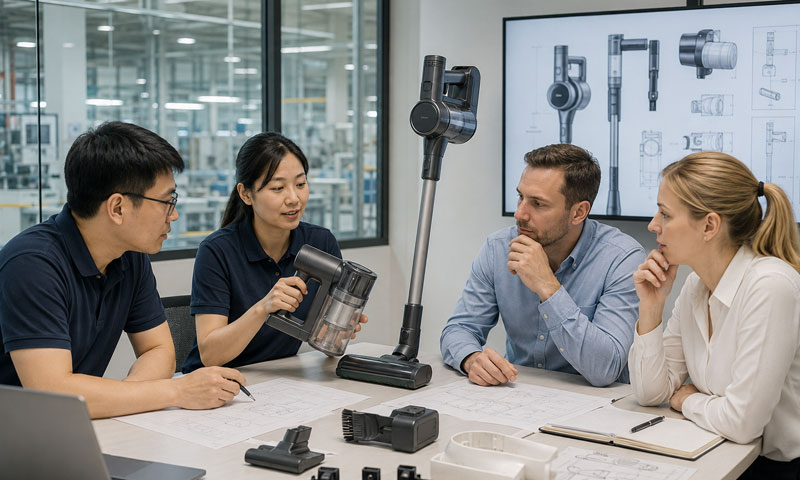
How to Validate an AI Robot Vacuum Before Mass Production
Validation is a repeatable test program that measures navigation, cleaning, docking, software, reliability and user experience across representative environments before the product is approved for mass production.
Build multiple test rooms instead of one perfect demonstration area. Include open space, narrow passages, chair clusters, low furniture, thresholds, dark surfaces, reflective objects, rugs, cables and common clutter. Use defined floor plans so that route efficiency and missed area can be compared between firmware versions. Record completion time, coverage, interventions, battery use and recovery from blocked paths.
Create an obstacle test library. Position objects at defined locations and repeat approaches from multiple angles. Score avoidance distance, contact, pushing, tangling and false detection. Separate safety-critical events from convenience events. A robot becoming tangled in a cable is different from lightly touching a chair leg. The acceptance criteria should reflect the product claim.
Measure cleaning with controlled debris. Apply known quantities of fine dust, crumbs, hair and larger particles to hard floor and carpet panels. Weigh pickup where practical. Test edge lines and corners. Repeat with a partially loaded dust box and used filter because performance may decline. For mopping, use controlled soil, measure visual residue and evaluate pad contamination.
Test transitions and recovery. Include thresholds at the claimed height, rug edges, table bases and narrow gaps. Move the robot during a task and observe relocalization. Block the planned path and see whether it reroutes. Interrupt Wi-Fi and confirm that basic cleaning can continue safely. Simulate low battery, dock blockage and a moved dock.
Dock testing should include repeated charging alignment, dust evacuation, mop washing, tank detection, empty or full tank states, bag-full behavior, drying, leak checks and cleaning of the tray. Use hair and mixed debris rather than only clean laboratory dust. Examine the dock after multiple cycles for residue and odor.
Reliability testing should cover wheel and brush endurance, bumper cycling, lidar or sensor operation, cliff sensors, tank and dust-box latches, charging contacts, pumps, valves, fans, heaters, dock mechanisms, packaging drops and transport vibration. The safety standard and laboratory plan define mandatory tests, while the brand adds use-related endurance targets.
Validate the app through a test matrix that includes supported operating systems, router types, account states, shared homes, schedules, map edits, time zones, updates and factory reset. Record every firmware and app version used during approval. The golden sample should be accompanied by software versions and configuration files, not only a physical unit.
Finally, run a pilot with production tooling, production components and normal operators. Review first-pass yield, software flashing, calibration, end-of-line tests and traceability. A robot may pass engineering validation but fail in mass production if sensor calibration or docking alignment varies. The pilot should prove that the factory can reproduce the approved behavior.
OEM and ODM Checklist for a Robot Vacuum Cleaner Manufacturer
An OEM and ODM checklist for a robot vacuum cleaner manufacturer verifies platform ownership, software responsibility, component control, test capability, production calibration, compliance and after-sales support.
| Area | Questions for the Manufacturer | Evidence |
|---|
| Platform ownership | Who owns mechanical design, electronics, firmware, app and cloud? | Responsibility matrix, agreements, development records |
| Sensor stack | Which lidar, cameras, lasers, ultrasonic and cliff sensors are used? | BOM, datasheets, approved alternatives |
| Navigation | How are mapping, relocalization and route planning validated? | Test plans, coverage data, firmware release notes |
| Cleaning system | How are suction, pickup, brush, hair, edge and mopping measured? | Repeatable debris tests and sample results |
| Dock | Which functions are included and how are leaks, residue and failures tested? | Function matrix, endurance and service plan |
| App and cloud | Who operates servers, supports users and maintains software? | Architecture, privacy documents, support SLA |
| Cybersecurity | How are credentials, updates, vulnerabilities and account deletion handled? | Security test report and response process |
| Calibration | Which sensors or assemblies require production calibration? | Fixtures, work instructions, traceability |
| Quality control | What are the end-of-line and sampling tests? | Control plan, limits, defect data |
| Service | Which modules and consumables can be replaced? | Parts list, repair guide, availability commitment |
A mature robot manufacturer should explain dependencies. A new obstacle-recognition model may require a different processor or camera. A new dock function may require mechanical and firmware changes. A higher suction mode may reduce runtime and increase noise. A new app design may affect schedule and cloud cost. Suppliers who present every change as simple may be underestimating validation.
Ask about model continuity. Robot platforms depend on sensors, chips and software services that can become obsolete. The supplier should have a process for component end-of-life, alternative qualification and firmware support. A buyer needs enough notice to manage certifications, inventory, spare parts and marketplace listings.
Clarify exclusivity and reuse. A modified housing may be exclusive while the internal platform remains common. A custom firmware feature may be reserved for a region or channel. Tooling ownership should be documented. App names, icons, package identifiers, cloud accounts and user data responsibilities should be explicitly assigned.
Commercial terms should include sample stages, tooling, software fees, cloud fees, certification support, MOQ, component commitments, lead time and spare parts. Compare total program cost rather than the robot price alone. A low hardware price can be offset by expensive app customization, ongoing cloud charges, high accessory cost or poor return performance.
For buyers that also need manufacturing and quality evidence, Wintech’s cleaning appliance manufacturer information should be reviewed together with factory audit documents, current company data, testing records and the specific project responsibility matrix.
AI Robot Vacuum Platform Scorecard
An AI robot vacuum platform scorecard converts technical observations into a weighted decision that reflects the target channel and product position.
| Category | Suggested Weight | Example Measures |
|---|
| Navigation and coverage | 15% | Map accuracy, missed area, repeat cleaning, recovery and multi-room completion |
| Obstacle behavior | 15% | Avoidance, contact, tangling, false positives and low-object detection |
| Vacuum performance | 15% | Hard-floor and carpet pickup, edge cleaning, hair and filter loading |
| Mopping performance | 10% | Soil removal, water control, carpet response and pad contamination |
| Dock automation | 10% | Emptying, washing, refill, drying, residue, leak and maintenance |
| App and firmware | 10% | Setup, map tools, schedules, updates, stability and recovery |
| Reliability and quality | 15% | Endurance, calibration, first-pass yield, traceability and corrective action |
| Compliance and security | 5% | Exact model documentation, privacy, cybersecurity and update governance |
| Commercial support | 5% | MOQ, lead time, parts, software support, cloud cost and communication |
The weights should change by product strategy. A value robot without a camera may place more weight on route stability and cleaning. A premium object-recognition model should place more weight on detection and software. A station-led product should increase dock reliability and maintenance weight. Safety, legal and critical data-security failures should remain pass/fail gates rather than weighted trade-offs.
Score multiple units and firmware versions. Variation matters. One robot may map perfectly while another loses localization because of sensor alignment. Use the average, worst-case result and failure frequency. Require corrective action for recurring failures before mass production.
Include customer-service simulation. Ask a new user to set up the product from the retail box without engineering help. Observe pairing, map creation, tank filling, dock placement, maintenance and troubleshooting. Many return drivers appear during setup, not during controlled laboratory use.
Review the score after pilot production and again after the first field batch. Early customer data can reveal home layouts, routers, floor transitions and object types that were not represented in development. The supplier and brand should have a process for prioritizing firmware fixes without destabilizing previously working functions.
Frequently Asked Questions
These frequently asked questions address the most common technical and sourcing concerns around AI cleaning robots.
1. Does every robot vacuum use AI?
No. Some robots use simple rules and random movement, while others use mapping, sensor fusion or machine-learning models. The product claim should identify the AI-related function, such as object classification, adaptive cleaning or semantic mapping.
2. Is lidar better than camera navigation?
Neither is universally better. Lidar provides strong geometric distance information and works without visible light, while cameras can provide richer object information. Many strong systems combine sensors. The correct choice depends on cost, privacy, lighting, product height and required functions.
3. Is higher suction always better for a robot vacuum?
No. Pickup also depends on airflow, brush design, floor contact, seals, filter resistance and path coverage. High suction can increase noise and battery use. Compare repeatable debris pickup in the intended mode and surface.
4. What does a self-cleaning robot vacuum station clean?
The term varies. A station may empty dust, wash mop pads, refill water, collect dirty water or dry mops. Buyers should list each function separately and avoid implying that the entire robot becomes maintenance-free.
5. What data can a robot vacuum collect?
Depending on the design, it may collect account details, device identifiers, maps, schedules, diagnostics and sensor data. Camera products may process images. Buyers should document what is collected, where it is processed, retention, third parties and deletion options.
6. What should be included in an OEM robot vacuum test plan?
Include mapping, coverage, obstacle sets, thresholds, carpet, cliff behavior, debris pickup, edge cleaning, hair, mopping, docking, app functions, Wi-Fi loss, firmware updates, endurance, packaging and pilot-production calibration. Record the exact hardware and software version.
External References
The following references support performance, AI-risk and cybersecurity concepts discussed in this article:
Conclusion
An AI robot vacuum cleaner should be evaluated as a connected system. Sensors provide observations, mapping estimates position and space, planning selects actions, cleaning hardware removes soil, the dock restores the machine, and software connects the user to the product. A weakness in any layer can damage the overall experience even when individual specifications look strong.
For sourcing teams, the most important practice is to replace labels with testable functions. Define which objects should be detected, how coverage is measured, what surfaces are supported, what the dock actually automates, what data is collected and who supports firmware after launch. Validate multiple units in realistic environments and repeat the tests during pilot production.
Wintech can discuss AI robot cleaner platforms, customization, validation and manufacturing requirements with international buyers. A productive brief should identify target markets, price position, navigation and obstacle expectations, vacuum and mopping functions, station requirements, app and cloud needs, privacy expectations, forecast and launch timing. That information allows both sides to select an appropriate platform and build a validation plan around the functions that matter to customers.

 EN
EN