Floor-care products are often grouped together even when they solve different problems. A wet and dry vacuum cleaner may collect loose debris and wash a hard floor in one pass. A floor washer may focus on controlled water delivery, roller agitation and dirty-water recovery. A vacuum mop may be used as a broad consumer term for a machine that combines vacuuming and mopping. An electric mop may provide powered scrubbing without meaningful debris pickup. A spot cleaner is designed for localized extraction from carpets, upholstery or car interiors. These labels overlap in online searches, yet the engineering, user expectations and after-sales risks are not the same.
For appliance brands, importers and retailers, the correct comparison is not simply “Which machine has the strongest suction?” The better question is “Which cleaning system matches the target floor, mess type, user behavior, price point and service model?” This guide compares the categories from a product-selection and OEM/ODM perspective. It uses practical performance factors, maintenance requirements and market-positioning logic so that buyers can select a platform that is easier to explain, sell and support.
Wintech develops multiple cleaning-appliance categories, including wet-and-dry floor cleaners, electric mops, spot cleaners, cordless stick vacuums and robotic products. The examples below show how a buyer can translate consumer needs into a product portfolio. Specifications and legal requirements should always be confirmed for the exact model, target market and approved production configuration.
What Is a Wet and Dry Vacuum Cleaner?
A wet and dry vacuum cleaner is a cleaning appliance designed to collect dry debris and liquid, although the term may refer either to a traditional canister-style wet/dry vacuum or to a modern cordless floor-washing vacuum.
This distinction matters because the two product families have different jobs. A traditional wet/dry canister vacuum is commonly associated with workshops, garages, renovation debris, spills and larger-capacity collection. A modern cordless wet-and-dry floor cleaner is normally designed for sealed hard floors. It dispenses clean water or solution, agitates the surface with a roller, collects dry debris and dirty liquid, and separates clean and dirty water. Its value proposition is one-pass daily floor care rather than heavy-duty debris collection.
On ecommerce pages and in keyword tools, phrases such as wet vacuum, wet dry vacuum carpet cleaner, floor washer, vacuum mop and wet floor vacuum may overlap. A manufacturer page must therefore define the product in the first paragraph. If a cordless hard-floor washer is described only as a “wet and dry vacuum,” buyers may expect workshop or carpet-extraction functions that the product was not designed to provide. Clear scope reduces irrelevant traffic, product misuse and customer complaints.
Wintech’s current wet-and-dry category presents a cordless floor-care format with vacuuming, washing, self-cleaning and flat-recline functions. Public specifications for the DWV101 include 200 W working power, suction listed at 13 kPa, a 5000 mAh battery, up to 60 minutes of runtime under the stated configuration, one-click self-cleaning, adjustable hot-air drying and a 180-degree flat-lay design. These numbers help buyers understand the platform, but they should be verified against the exact approved sample, power mode and accessory configuration.
What Is a Floor Washer or Vacuum Mop?
A floor washer or vacuum mop is a hard-floor appliance that combines liquid application, mechanical agitation and dirty-water recovery, often with enough suction to collect everyday dry debris during the same pass.
The term “floor washer” usually communicates the cleaning process more accurately than “vacuum mop.” A roller or pad contacts the floor, clean water is metered onto the cleaning element or surface, and dirty water is recovered into a separate tank. The machine may also collect crumbs, hair and dust. The quality of the result depends on the roller design, water control, pickup path, squeegee or scraper geometry, edge reach, turning behavior and how the system manages hair and debris inside the dirty-water path.
“Vacuum mop” is a useful search phrase because consumers use it widely, but it can describe several architectures. It may refer to a cordless floor washer, a robot vacuum with a mop pad, a stick vacuum with a passive mop attachment or a machine with separate vacuum and mopping modes. A product page should define the architecture before discussing features. Otherwise, traffic may increase while conversion remains low because visitors cannot tell what the product actually does.
For OEM buyers, the architecture affects product claims, tooling, cleaning performance, maintenance and return reasons. A dual-tank roller floor washer must manage water sealing, roller cleaning, dirty-water odor, tank detection and self-cleaning. A stick vacuum with a mop attachment may be lighter and simpler but may not recover dirty water. A robot vacuum-mop adds navigation, dock functions and app expectations. These products should not be treated as interchangeable solely because they all use the word “mop.”
Wet and Dry Vacuum Cleaner vs Electric Mop: The Core Difference
The core difference is that a wet and dry vacuum cleaner normally recovers debris and dirty liquid, while an electric mop mainly powers the scrubbing or wiping action and may leave debris collection to a separate vacuum.
An electric mop can be an effective product when the user already owns a vacuum cleaner and wants less physical effort during wet cleaning. Rotating pads, powered rollers or oscillating heads can improve contact with the floor and reduce manual scrubbing. The architecture is generally simpler because it may not need a suction motor, debris channel, dirty-water separator or complex self-cleaning path. That can support a lower price, lighter body and easier service.
A wet-and-dry floor washer is intended to reduce the number of cleaning steps. It can collect crumbs, dust, hair and liquid while washing the floor. The benefit is time and convenience, especially in kitchens, dining areas, homes with children or pets, and high-frequency hard-floor cleaning. The added complexity creates additional design responsibilities: water tanks must seal correctly, wet debris must move through the pickup path, the roller must resist odor and residue, and the dirty-water tank must be easy to empty and clean.
For a retailer, the difference should be translated into a simple consumer promise. The electric mop is “powered mopping after debris is removed.” The wet-dry floor washer is “vacuum and wash in one pass on compatible sealed hard floors.” This wording is more useful than a feature list because it sets expectations about workflow. It also reduces negative reviews from users who expect an electric mop to vacuum or expect a floor washer to clean every carpet.
For a private-label program, the selection depends on target price and channel. An electric mop may fit an entry-level or complementary cleaning-tool range. A wet-and-dry floor washer can support a higher-value position but requires stronger quality assurance, spare rollers, filters, cleaning brushes, tank parts and user education. The buyer should model not only the product cost but also the accessory and service ecosystem.
Wintech’s electric mop and vacuum category can help buyers compare mopping-focused products with integrated floor-washing platforms. The exact function of each model should be confirmed because search phrases often combine architectures that are technically different.
Wet and Dry Vacuum Cleaner vs Spot Cleaner: Different Surfaces and Different Water Systems
A wet and dry floor cleaner is primarily designed for broad hard-floor cleaning, while a spot cleaner sprays and extracts liquid from localized carpet, upholstery, mattress or vehicle-interior stains.
A spot cleaner uses an extraction workflow. Cleaning solution is applied to a fabric surface, a brush agitates the stained area, and suction removes liquid and loosened soil. The nozzle, spray pattern, hose, recovery tank and cleaning formula are central to performance. The user normally works on a defined stain or small area rather than moving a full-width roller across a room.
A hard-floor washer uses a continuous floor-contact system. It must meter water across a roller or cleaning path, maintain pickup at the rear of the head and leave a reasonably dry surface. It needs to handle everyday debris without clogging while keeping the roller supplied with clean liquid. The machine may have self-cleaning and drying functions because the roller remains part of the appliance.
The categories also create different after-sales questions. Spot-cleaner users may ask about detergent compatibility, hose cleaning, fabric colorfastness, residual moisture and stain pretreatment. Floor-washer users may ask about streaks, roller odor, dirty-water sensors, edge cleaning, hair in the scraper and whether the product is safe for wood or laminate. A brand should prepare separate manuals, troubleshooting content and spare-parts plans.
Do not market a floor washer as a carpet extractor unless the platform and tests support that use. A roller floor washer may cross a thin mat or detect carpet for operational reasons, but that does not make it a deep carpet cleaner. Similarly, a spot cleaner may remove liquid and stains from upholstery but is not intended for daily whole-room hard-floor maintenance.
For buyers planning a broader range, the spot upholstery cleaner category can complement a wet-dry floor product because the two machines address different surfaces and cleaning occasions. Portfolio logic is stronger when each product has a clear job rather than overlapping claims.
Which Product Fits Each Cleaning Scenario?
A scenario-based selection matches the machine to the surface, soil type, cleaning frequency and user workflow instead of selecting a category by name alone.
| Cleaning Scenario | Best-Fit Product | Why It Fits | Main Limitation to Explain |
|---|
| Daily crumbs, hair and light spills on sealed hard floors | Cordless wet-and-dry floor washer | Collects dry debris and washes in one pass | Not a substitute for deep carpet extraction |
| Routine wet wiping after vacuuming | Electric mop | Simple, light and focused on powered scrubbing | May not collect loose debris or dirty liquid |
| Sofa, carpet, stairs and car-seat stains | Spot cleaner | Targeted spray, agitation and extraction | Small-area cleaning; drying time depends on extraction and fabric |
| Large dry debris and liquid in garage or workshop | Traditional canister wet/dry vacuum | High-capacity collection and rugged use | Different category from a domestic cordless floor washer |
| Daily automated vacuuming with light mopping | Robot vacuum-mop | Scheduled hands-free maintenance | Cannot replace every manual deep-cleaning task |
| Whole-home carpet and hard-floor dry cleaning | Cordless stick vacuum | Flexible dry pickup and multiple floor heads | No dirty-water recovery unless a dedicated wet module is used |
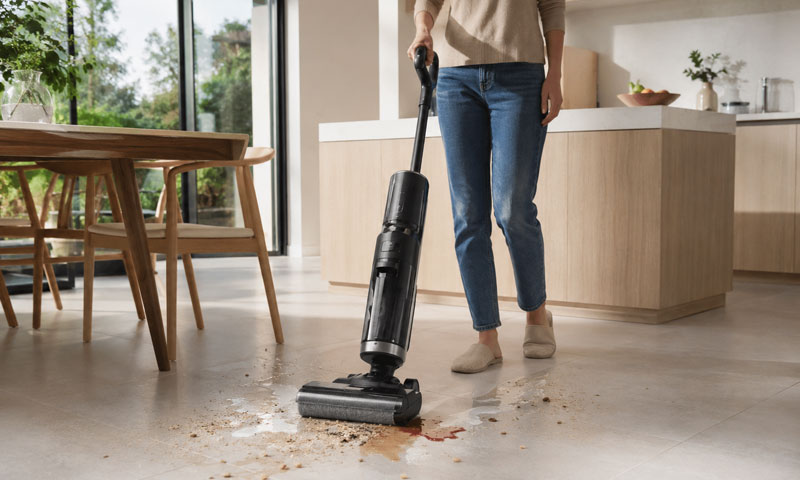
Kitchen and dining areas are strong applications for a floor washer because debris and liquid often occur together. The product should pick up cereal, crumbs, hair and small spills without pushing them ahead of the roller. The buyer should test mixed debris, not only clean-water pickup. Test at the front edge, wall edge and during turns because many complaints arise from areas the machine misses.
Homes with pets create a different challenge. Hair may wrap around rollers, collect in scrapers, block narrow channels or mix with wet debris. Evaluate the complete cleaning path and the ease of manual cleaning. A self-cleaning cycle can wash the roller, but it may not remove every long hair from the roller ends or scraper. The manual and accessory kit should show the user how to remove these materials safely.
Wood and laminate require careful claim language. The product may be suitable for sealed hard floors, but water output, dwell time, edge leakage and user speed affect the result. Avoid broad statements that imply all wood floors are safe. The manufacturer and brand should define compatible surfaces and instruct users to follow the flooring supplier’s guidance.
For elderly users or people with limited strength, self-propulsion, handle angle, center of gravity, tank removal and cleaning effort may matter more than maximum suction. A product that feels light during forward movement may become difficult when turning or carrying upstairs. Include filled-tank weight and storage behavior in user testing.
For small apartments, storage and odor control are important. A dock that holds the machine, dries the roller and organizes accessories may improve the experience. However, heating and drying functions add energy, noise, electronics and safety considerations. The value should be tested against target price and the buyer’s warranty model.
How to Compare Water Management, Self-Cleaning and Drying Systems
Water-management systems control how clean liquid is stored and delivered, how dirty liquid and debris are separated, and how the machine is cleaned and dried after use.
Start with tank design. The clean-water tank should be easy to fill without confusing it with the dirty-water tank. The cap, valve and seals should resist leakage in storage and during movement. The dirty-water tank should be easy to remove, empty and rinse. Internal corners, strainers and floats should be accessible enough to prevent residue buildup. A larger tank can extend cleaning time but increases weight and may make the product harder to maneuver.
Water delivery should be consistent across the cleaning path. Excess water may cause streaks, longer drying time or floor concerns. Insufficient water may leave the roller dirty and reduce stain removal. Some products vary water output by mode or sensor input. If the marketing claim includes automatic dirt detection, the buyer should understand what the sensor measures and how it changes water, suction or roller speed.
Dirty-water recovery is not determined by suction alone. The geometry of the roller, scraper, suction inlet and squeegee influences how much liquid remains on the floor. Test slow and fast passes, turns, stopping, reverse movement and edge cleaning. Measure or compare residual moisture under repeatable conditions. User perception also matters: a visually streak-free floor may be more important than a theoretical maximum pickup number.
A self-cleaning cycle normally rotates the roller while flushing it and moving dirty liquid into the recovery tank. It reduces manual work but does not eliminate the need to empty tanks, clean filters and inspect the brush chamber. Marketing should say “helps clean the roller and internal path” rather than implying that the machine never needs manual maintenance.
Drying systems may use room-temperature airflow, heated air or a combination of rotation and airflow. Heated drying can reduce roller odor and moisture, but the design must manage temperature, time, noise and energy. Wintech’s public DWV101 description lists adjustable hot-air drying up to 75°C; for a private-label program, the buyer should verify the measured temperature location, control logic, safety protections and cycle duration for the exact sample.
Odor prevention is a system outcome. It depends on how thoroughly dirty water is removed, whether debris remains in hidden channels, how fast the roller dries, whether the filter stays wet and whether the user follows cleaning instructions. Include odor and residue assessment in extended-use trials, not only in a new-sample demonstration.
How to Evaluate Cleaning Performance Without Relying on One Number
Cleaning performance should be evaluated through repeatable pickup, washing, maneuverability and maintenance tests that represent the target household rather than through one suction or wattage figure.
Build a debris set. For dry pickup, use fine dust, crumbs, cereal, pet hair and larger particles that match the market. For wet pickup, use water and representative household liquids where safe. For washing, use controlled soils such as dried beverage, light grease substitute or tracked dirt on defined hard-floor panels. Record the quantity applied, number of passes, mode, water setting, roller condition and remaining residue.
Test different floor textures. Smooth tile, textured tile, sealed wood simulation, laminate and grout lines may produce different results. A roller that works well on smooth flooring may leave debris in deep grout. Edge cleaning should be tested on both sides if the product claims dual-edge reach. Test corners and around table legs because floor-head geometry affects real coverage.
Evaluate mixed debris. A floor washer must often handle hair, crumbs and liquid together. Some systems collect large debris effectively when dry but struggle when it becomes wet and sticky. Observe the inlet, separator and dirty-water tank. Check whether debris is easy to dispose of or creates a messy slurry that users must touch.
Test the machine as the tank fills and the roller becomes dirty. Initial performance with a clean roller and empty tanks may not represent a full room. Observe whether suction, water delivery or maneuverability changes. Confirm how the machine alerts the user when the dirty-water tank is full or the clean-water tank is empty.
Include usability metrics. Measure setup time, tank filling, mode selection, push-pull force, turning radius, reach under furniture, noise, visibility of the cleaning path, tank emptying and post-cleaning maintenance. A product can achieve strong laboratory pickup but receive poor reviews if cleaning the machine takes longer than cleaning the floor.
For a B2B comparison, use a weighted scorecard. A family-focused product may weight mixed debris, edge cleaning, self-cleaning and odor control heavily. A compact urban product may weight storage, weight and noise. A premium product may be expected to provide better displays, sensor behavior, dock organization and drying. The same test results can support different product positions when the target user is clear.
OEM and ODM Decisions for Wet Vacuum Cleaner Suppliers
OEM and ODM decisions for wet vacuum cleaner suppliers determine how much of the water system, airflow path, mechanical design, tooling, electronics, claims and service model will be changed for the buyer.
Begin with a mature platform whenever the launch schedule is tight. Water-handling appliances have more leakage, odor and maintenance risks than a simple dry vacuum, so a validated architecture is valuable. Ask how long the platform has been in production, which components have changed, what field failures have occurred and how the current version addresses them.
Cosmetic customization may include colors, decorative parts, logos, packaging and user-interface graphics. Functional customization may include tank volume, roller material, edge design, display, water modes, drying cycle, cleaning solution, battery, charger or accessory set. Functional changes should trigger an engineering impact review. A larger tank changes weight and balance. A more aggressive roller may improve scrubbing but increase noise or floor sensitivity. A stronger heater changes power, temperature and safety validation.
Clarify cleaning-solution policy. Some platforms are designed for water only or for a specific low-foaming formula. High-foaming detergents can interfere with dirty-water sensing or airflow. The brand should decide whether it will sell a proprietary solution, approve a general type or instruct users to use only water. This decision affects claims, recurring revenue, customer convenience and support.
Define replaceable parts. Rollers, filters, cleaning brushes, tank seals, caps and dock trays may need replacement during the product life. Ask for part codes, packaging, lead times and minimum quantities. A product with excellent first-year sales can create customer dissatisfaction if basic consumables are unavailable in year two.
Quality plans should include leakage checks, pump or valve function, tank detection, dirty-water shutoff, roller drive, suction path, self-cleaning, drying, charging, temperature protection and final appearance. Packaging tests should consider residual water from production testing; the factory needs a controlled drying procedure before packing.
Wintech’s wet and dry vacuum cleaner category provides an entry point for buyers evaluating an integrated hard-floor platform. A detailed project review should confirm which features belong to the selected model and which require development or new validation.
Product Portfolio and Channel Positioning
Product portfolio positioning assigns each cleaning appliance a clear consumer job, price role and channel story so that the range expands coverage without creating confusing overlap.
An entry-level portfolio might pair a cordless stick vacuum with an electric mop. The stick vacuum handles dry debris across carpets and hard floors, while the mop handles wet cleaning. The two products are easier to explain and may have lower individual price points, but the user performs two steps. This combination can work in channels where customers already understand separate vacuuming and mopping.
A mid-to-premium portfolio may use a cordless stick vacuum plus a wet-and-dry floor washer. The stick vacuum remains the flexible whole-home dry cleaner for carpets, upholstery and above-floor cleaning. The floor washer is positioned for fast hard-floor maintenance. The products complement rather than replace each other. Bundles, shared design language and coordinated accessories can strengthen brand identity.
A fabric-care extension may add a spot cleaner. This creates a “floor and upholstery” story without forcing one product to make unsupported claims. The spot cleaner can target homes with children, pets, sofas, rugs and cars. A mattress vacuum or dust-mite controller can extend the range into bedding and hygiene-focused cleaning.
Retailers need clear shelf and online comparison. Use a “best for” label, compatible surfaces, cleaning method and key maintenance requirement. Avoid putting five products into a table with only wattage and battery capacity. Those numbers do not explain why a shopper should choose one category. A useful comparison might say: stick vacuum for dry whole-home cleaning, wet-dry washer for one-pass hard-floor cleaning, electric mop for powered wiping, and spot cleaner for fabric stains.
Claims should be consistent across packaging, product page, marketplace listing and manual. If a product is described as self-cleaning, explain what the cycle cleans and what the user must still do. If it is described as edge-to-edge, state which side or sides. If runtime is “up to 60 minutes,” state the mode. Clear claims improve conversion because buyers understand the value, and they reduce returns because the delivered function matches the promise.
Buyer Comparison Table
The buyer comparison table below summarizes the practical differences among five common floor-care categories.
| Category | Primary Job | Dry Debris Pickup | Dirty-Water Recovery | Carpet/Upholstery Use | Maintenance Complexity | Typical Market Position |
|---|
| Cordless wet-dry floor washer | Vacuum and wash sealed hard floors in one pass | Yes, for everyday debris | Yes | Generally limited; confirm exact design | Medium to high | Mid to premium convenience |
| Electric mop | Powered wet wiping or scrubbing | Limited or none | Usually no separate recovery | No | Low to medium | Entry to mid |
| Spot cleaner | Localized spray extraction | Not the main purpose | Yes | Yes, on compatible fabrics | Medium | Complementary specialist product |
| Cordless stick vacuum | Dry whole-home and above-floor cleaning | Yes | No | Dry carpet and upholstery tools | Low to medium | Core floor-care product |
| Robot vacuum-mop | Automated daily maintenance | Yes | Depends on dock and system | Light carpet vacuuming; not extraction | Medium to high | Smart-home convenience |
Use the table as a starting point, not as a substitute for model verification. Product names are not standardized across every supplier. A model marketed as an electric mop may include suction, while another may use rotating pads only. A robot “self-cleaning” station may wash mops but not clean the dust path. The buyer should describe the required process and ask the supplier to map the exact architecture.
When comparing quotations, include the cost of consumables and service. A wet-dry washer may need replacement rollers and filters. A spot cleaner may need hoses, nozzles and compatible solution guidance. An electric mop may need pads. A robot may need bags, brushes, filters, mop pads and dock parts. The recurring accessory strategy can improve customer retention, but unavailable consumables create poor reviews.
Frequently Asked Questions
These frequently asked questions clarify product boundaries and the most common purchasing decisions.
1. Is a wet and dry vacuum cleaner the same as a floor washer?
Sometimes, but not always. A modern cordless wet-and-dry floor cleaner is often a floor washer, while a traditional wet/dry canister vacuum is a different product for larger debris and spills. Product pages should define the architecture and intended surfaces.
2. Can a wet-and-dry floor washer clean carpet?
Most roller floor washers are designed primarily for sealed hard floors. Some can cross or refresh certain rugs, but they are not automatically deep carpet extractors. Follow the exact model instructions and test claims before marketing carpet use.
3. Does an electric mop vacuum dirt?
Many electric mops do not provide meaningful vacuum pickup. They power the wiping or scrubbing action after loose debris has been removed. Some hybrid products include suction, so buyers should verify the actual cleaning path rather than relying on the category name.
4. What is the main maintenance task for a wet-dry vacuum?
The user should empty and rinse the dirty-water tank, maintain the filter, remove hair or debris from the roller area and run the approved self-cleaning cycle. The roller should dry thoroughly to reduce odor. Exact steps depend on the model.
5. Which product is best for pet homes?
A wet-dry floor washer is useful for mixed hard-floor messes, while a cordless stick vacuum is better for carpets, sofas and above-floor hair. A spot cleaner helps with localized fabric stains. Many pet homes benefit from a complementary portfolio rather than one universal product.
6. What should a private-label buyer test before approving a floor washer?
Test mixed debris pickup, liquid recovery, streaking, edge cleaning, hair handling, tank leakage, self-cleaning, roller drying, odor after repeated use, battery runtime, turning, storage, noise and all user-maintenance steps. Use the intended production configuration and packaging.
External References
The following external resources provide standards and background relevant to household vacuum and wet-cleaning appliances:
Conclusion
A wet and dry vacuum cleaner, floor washer, vacuum mop, electric mop and spot cleaner may appear in the same search journey, but they are not interchangeable. The best product is the one whose cleaning process matches the surface, soil, frequency and user workflow. A clear product definition is therefore the first step in both SEO and product strategy.
For buyers, the decision should include water delivery, debris pickup, dirty-water recovery, roller and scraper design, tank usability, self-cleaning, drying, odor control, service parts and claim boundaries. Performance should be tested with representative debris and repeated use, not inferred from one suction or wattage number.
Wintech can support product discussions across integrated hard-floor washers, mopping products, spot cleaners and dry vacuum categories. A useful project brief should identify the target market, surfaces, primary messes, price position, desired cleaning workflow, customization needs, compliance requirements and expected order volume. This allows the manufacturer and buyer to select a platform with a clear consumer job and a supportable commercial model.

 EN
EN