In 2026, the cost of unplanned downtime on an automated production line has reached a level that makes dust control a financial priority, not a housekeeping task. A single photoelectric sensor obscured by fine particulate can trigger a false alarm that stops a robotic cell. A clogged cooling intake on a servo drive can cause thermal shutdown that halts an entire assembly sequence. A layer of conductive dust on a PLC cabinet's internal components can create leakage paths that produce intermittent faults that take hours to diagnose. In each case, the root cause is dust — and the cost is measured in OEE percentage points, scrap rates, and emergency maintenance labor that compounds across every shift.
An electrical dust cleaner — a powered dust extraction system that captures particulate through controlled suction and filtration rather than dispersing it — is the tool that allows Industry 4.0 plants to move from reactive "blow-it-off" cleanup to a repeatable, documented dust control program. Wintech positions itself as a vacuum cleaner manufacturer with OEM and ODM capability and a broad electric cleaner product portfolio, covering the range of powered dust removal solutions that automated production environments require — from mobile heavy-duty units for maintenance routes to station-based systems for continuous cleaning at high-dust process points.
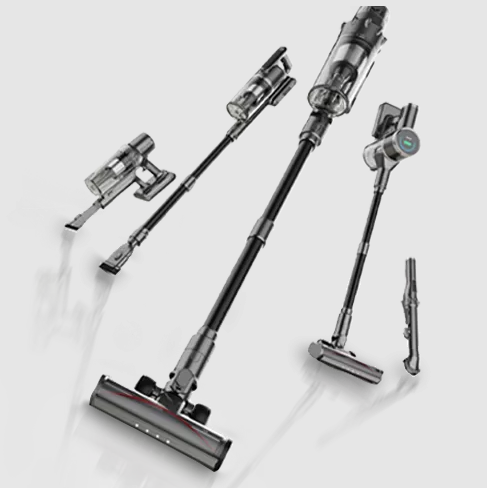
Industry 4.0 Dust Risks in 2026: Why Automated Lines Need Dedicated Electrical Dust Cleaner Procedures
The automation density of a 2026 smart factory creates a dust sensitivity profile that is fundamentally different from a conventional manufacturing environment. The same floor area that previously contained a handful of manually operated machines now contains dozens of sensors, vision systems, servo drives, linear guides, and robotic end-effectors — each of which has a specific dust tolerance threshold below which performance degrades or failure occurs.
The Precision Vulnerability Map
Photoelectric sensors and machine vision cameras are the most dust-sensitive components on a modern production line. A thin film of fine dust on a photoelectric sensor lens reduces the signal-to-noise ratio of the detection signal, producing false triggers or missed detections that generate scrap, jam the line, or cause a safety stop. A dust-contaminated vision camera lens reduces image contrast and edge definition, causing the inspection algorithm to reject good parts or pass defective ones — both outcomes with direct quality and cost consequences.
Linear guides and ball screws accumulate dust in their recirculating element channels, increasing friction, accelerating wear, and eventually causing positioning errors that exceed the tolerance of the process. Servo drive cooling intakes clogged with fine dust reduce airflow through the heat sink, raising the drive's operating temperature and triggering thermal protection shutdowns that stop the axis without warning.
Control cabinet interiors accumulate dust on PCB surfaces, connector contacts, and cooling fan blades. Fine conductive dust — metal swarf, carbon black, or graphite from worn components — creates resistive leakage paths between circuit nodes that produce intermittent faults that are difficult to reproduce and expensive to diagnose.
The 2026 Operational Pain Points
Higher automation density means higher downtime cost per minute. A production line that generates 500 units per hour at a margin of 20 dollars per unit loses 167 dollars per minute of unplanned downtime — a number that makes a 30-minute sensor fault caused by dust contamination a 5,000-dollar event before maintenance labor is counted.
Tighter quality tolerances mean that small contamination events become scrap or return events. A vision inspection system that was calibrated with clean optics and is now operating with a dust-contaminated lens does not fail obviously — it drifts gradually, passing parts that are marginally out of specification until a customer return or an audit catch reveals the problem.
Audit and EHS pressure means that cleaning must be documented, repeatable, and safe. An industrial electrical dust cleaner that is part of a standard PM route — with defined cleaning points, frequencies, and acceptance criteria — produces the documentation trail that an EHS audit or a quality system review requires. A compressed air gun used ad hoc by whoever notices the dust does not.
How an Industrial Electrical Dust Cleaner Protects Electronics Better Than Compressed Air
The fundamental difference between an electrical dust cleaner and compressed air as a dust removal method is the direction of the dust movement. Compressed air pushes dust away from the target surface — but it does not remove it from the environment. The dust that is blown off a sensor lens or a PCB surface becomes airborne, migrates to adjacent surfaces, and settles on the next sensitive component in the airflow path. In an enclosed control cabinet, compressed air can drive fine dust deeper into connector contacts and between PCB traces, making the contamination worse rather than better.
Controlled Negative Pressure Extraction
An electrical dust cleaner operates on the opposite principle: it creates a negative pressure at the cleaning nozzle that draws dust away from the target surface and into the collection system, where it is captured by the filtration stack and retained. The dust does not become airborne in the work environment — it is extracted from the environment entirely. This capture-at-source approach is the reason that dust control for electronics applications requires vacuum extraction rather than compressed air displacement.
The practical consequence for automated production line cleaning is that vacuum extraction reduces the total dust burden in the production environment over time, rather than redistributing it. A compressed air cleaning program moves dust from cleaned surfaces to uncleaned surfaces. A vacuum extraction program removes dust from the environment, reducing the rate at which sensitive components accumulate contamination between cleaning cycles.
Filtration as the Performance Differentiator
The filtration stack of an industrial electrical dust cleaner determines whether the extracted dust stays captured or is re-emitted through the exhaust. A single-stage filter that captures large particles but passes fine particulate re-emits the fine dust fraction — the fraction that is most damaging to sensors and electronics — back into the production environment through the vacuum exhaust. A multi-stage filtration system with a fine particle filter or HEPA-class final stage captures the fine fraction and retains it, producing clean exhaust air that does not recontaminate the work area.
For electronics-adjacent cleaning applications, the filtration specification is not a secondary consideration — it is the primary performance criterion. Wintech's product range includes models with HEPA-class filtration, providing the fine particle capture performance that dust control for electronics applications requires.
ESD and Static Management
Cleaning near sensitive electronics introduces an electrostatic discharge risk that compressed air cleaning also creates but that vacuum extraction can be managed to minimize. An anti-static hose and grounded vacuum body prevent the triboelectric charge buildup that can occur when a non-conductive hose moves rapidly over a surface, generating a static discharge that can damage ESD-sensitive components. For production environments where ESD-sensitive devices are handled or where ESD control is part of the quality system, confirm the ESD specification of the electrical dust cleaner before deploying it in those areas.
Key Specifications for a Heavy-Duty Electrical Dust Cleaner: The RFQ Checklist
Specifying an industrial electrical dust cleaner for an automated production environment requires locking the parameters that determine whether the unit will perform reliably under the duty cycle, dust type, and cleaning task requirements of the specific application.
Performance and Duty Cycle Parameters
| Parameter | What to Specify | Why It Matters |
|---|
| Suction and airflow | Match to dust type (fine powder vs mixed debris) and nozzle size | Undersized suction leaves fine dust on surfaces; oversized can damage delicate components |
| Duty cycle | Continuous use vs intermittent station cleaning | Continuous-duty motors and thermal designs differ from intermittent-use units |
| Filtration stack | Pre-filter plus fine filter or HEPA-class final stage | Determines whether fine dust is captured or re-emitted through exhaust |
| Dust container volume | Match to cleaning route length and dust generation rate | Larger bins reduce emptying frequency; sealed emptying reduces re-dispersion |
| Power system | Corded for fixed stations; cordless for mobile maintenance routes | Cordless units provide flexibility for robot cells and remote cabinet locations |
| Noise level | Specify maximum dB(A) for 24/7 lines and operator comfort | High noise in continuous operation creates compliance and fatigue issues |
Attachments for Automation Environments
The attachment set determines whether the electrical dust cleaner can reach the specific cleaning points that automated production line cleaning requires. A crevice tool accesses the narrow gaps between PCB components and connector rows in control cabinets. A soft brush attachment cleans sensor lenses, camera housings, and optical surfaces without scratching. A narrow nozzle accesses cable tray interiors and the spaces between servo drive fins. Confirm that the attachment set covers the specific cleaning points in the target application before finalizing the specification.
OEM and ODM Customization
Wintech explicitly offers OEM and ODM customization across its vacuum cleaner product range — covering private labeling, attachment configuration, packaging, and platform tailoring for specific operating environments. For production environments with specific requirements — ESD-rated hoses, custom nozzle geometries for specific machine types, or branded equipment for quality system documentation — OEM customization provides the specification control that a standard catalog product cannot.
Safety Note for Combustible and Conductive Dust
If the dust in the target environment is combustible — metal powder, wood dust, grain dust — or if it is conductive at concentrations that create an explosion risk, a standard electrical dust cleaner is not the correct tool. Combustible dust environments require dust collection equipment that is rated and certified for the specific dust hazard classification under the applicable standard (ATEX in the EU, NEC/NFPA in North America). Confirm the dust classification for the target environment before specifying any dust removal equipment, and do not substitute a non-rated unit for a rated one on the basis of cost or availability.
Application Scenarios: Automated Production Line Cleaning That Directly Improves OEE
Robot Cells
Robot cells accumulate dust on robot bases, cable carriers, end-effector shrouds, and safety scanner windows. Safety scanner contamination is a particularly high-cost failure mode — a dirty safety scanner window triggers a safety stop that halts the entire cell, and the fault may not be immediately identified as a cleaning issue, leading to extended diagnostic time. A scheduled cleaning route that includes safety scanner windows, robot base cooling intakes, and cable carrier interiors — using a soft brush attachment and a crevice tool — reduces the frequency of contamination-related safety stops and extends the service interval of the safety scanners.
Machine Vision and Inspection Stations
Machine vision inspection stations are the highest-sensitivity cleaning application on a production line. The cleaning protocol for a vision station must address the camera lens, the illumination housing, the diffuser panel, and the reflective surfaces that contribute to the optical path — not just the camera body. A soft brush attachment on an industrial electrical dust cleaner removes fine dust from these surfaces without the static generation risk of a dry cloth wipe and without the moisture risk of a wet wipe on an energized optical system.
Control Cabinets and Electrical Rooms
Control cabinet cleaning is the application where the choice between compressed air and vacuum extraction has the most direct consequence for equipment reliability. Compressed air cleaning of a control cabinet interior disperses fine dust from the PCB surfaces and connector contacts into the cabinet air volume, where it settles on adjacent components and accumulates in the cooling fan blades. Vacuum extraction removes the dust from the cabinet environment entirely, reducing the rate of contamination accumulation and the frequency of heat-related faults caused by clogged cooling paths.
Conveyors and Packaging Lines
Conveyor transfer points and packaging line sensor arrays accumulate product dust — flour, sugar, plastic granules, paper fiber — at rates that can block photoelectric sensors within a single shift. A station-based electrical dust cleaner positioned at high-dust transfer points provides continuous or scheduled extraction that keeps sensor faces clean without requiring manual intervention between PM cycles.
Selection Workflow, Maintenance, and TCO: Building a Repeatable Dust Control Program
Text-Based Selection and Deployment Workflow
Step one: map the dust sources and the most downtime-sensitive assets. Identify the production areas where dust generation is highest and the equipment where dust contamination has the highest downtime cost — vision systems, safety scanners, servo drives, and PLC cabinets are typically the highest-priority targets.
Step two: classify the dust. Determine whether the dust is fine or coarse, conductive or non-conductive, and combustible or non-combustible. The dust classification determines the filtration requirement, the ESD specification, and whether a standard electrical dust cleaner is appropriate or whether a rated dust collection system is required.
Step three: select the electrical dust cleaner type. A mobile heavy-duty unit covers multiple cleaning points on a PM route. A station-based unit provides continuous or scheduled extraction at a fixed high-dust location. A cordless unit provides flexibility for robot cells and remote locations where a power cord creates a trip hazard or access constraint.
Step four: specify the filtration and attachments. Confirm the filtration grade — fine filter or HEPA-class — based on the particle size of the dust and the sensitivity of the equipment being cleaned. Confirm the attachment set covers all the cleaning points in the target application.
Step five: pilot for two to four weeks. Measure the time saved per cleaning cycle, the reduction in sensor faults and nuisance stops, the filter loading rate, and operator compliance with the cleaning SOP. Use the pilot data to refine the cleaning frequency, the attachment selection, and the filter replacement interval before rolling out across the full production area.
Maintenance and TCO Framework
| Cost Item | Compressed Air Cleaning | Industrial Electrical Dust Cleaner |
|---|
| Dust removal effectiveness | Lower — redistributes fine dust rather than removing it | Higher — captures fine dust at source and retains in filter |
| Sensor fault frequency | Higher — redistributed dust recontaminates sensors | Lower — reduced dust burden reduces contamination rate |
| Emergency maintenance labor | Higher — reactive response to contamination-related faults | Lower — PM cleaning reduces fault frequency |
| Quality reject rate from dirty optics | Higher — vision system drift from lens contamination | Lower — scheduled lens cleaning maintains inspection accuracy |
| Filter and consumable cost | Not applicable | Scheduled filter replacement — predictable and budgetable |
| EHS and audit compliance | Lower — ad hoc cleaning is not documentable | Higher — PM route with defined cleaning points and frequencies |
| OEE impact | Negative — dust-related stops reduce availability | Positive — reduced stops improve availability and performance |
Conclusion
In 2026, dust is a direct threat to automation stability, quality yield, and OEE — not a minor housekeeping issue. A properly specified industrial electrical dust cleaner, deployed as part of a documented PM cleaning program with the correct filtration, duty cycle, and attachment set for the specific production environment, converts dust control from a reactive cost into a proactive reliability investment. The OEE improvement from reduced sensor faults, fewer nuisance stops, and lower emergency maintenance labor typically pays back the equipment cost within the first operating quarter for a high-density automated line.
As a portable vacuum supplier, Wintech's electric cleaner portfolio — with OEM and ODM customization capability for specific operating environments — provides the starting point for specifying a heavy-duty vacuum system that matches the dust type, duty cycle, and electronics-adjacent cleaning requirements of an Industry 4.0 production environment. Visit the Wintech product page to review the full range and submit your requirements for a matched configuration recommendation and quotation.
Get Your Recommended Configuration and Quote
Visit the Wintech product page to review the full range, then submit the following details to receive a matched configuration and quotation:
| Parameter | What to Provide |
|---|
| Work condition | Production area type, dust type (fine, conductive, or combustible), indoor air constraints, ESD requirements, cleaning frequency |
| Quantity | Number of lines or stations, shift pattern, required units and spares |
| Size and spec | Corded or cordless, target runtime, dustbin size, attachment set, filtration level (fine filter or HEPA-class), noise limit |
| Target metrics | Suction and airflow target, filter service interval target, OEE improvement goal, acceptable downtime for maintenance |
| Current problem | Sensor false alarms, robot cell faults, overheating from clogged vents, high cleaning labor cost, dust re-dispersion from compressed air |
FAQ
1. What is an electrical dust cleaner?
An electrical dust cleaner is a powered dust removal device — typically an electric vacuum or dust extraction system — that captures dust through suction and filtration rather than dispersing it. In industrial applications, it is used to remove fine particulate from sensors, control cabinets, robot cells, and production line equipment as part of a preventive maintenance program. Wintech manufactures a range of electric cleaner products with OEM and ODM customization capability for specific production environments.
2. Electrical dust cleaner vs compressed air vs central dust collection — which is better?
Compressed air is fast but redistributes fine dust into the environment rather than removing it, and can drive conductive dust deeper into connectors and PCB surfaces. Central dust collection is effective for fixed high-dust sources but is not practical for every sensor housing, cabinet interior, and robot cell in a large production area. An industrial electrical dust cleaner — mobile or station-based — provides flexible, repeatable capture at the point of maintenance, making it the most practical complement to central systems for electronics-adjacent cleaning in automated production environments.
3. How does an electrical dust cleaner improve OEE?
Payback comes from three measurable sources. Fewer nuisance stops from sensor contamination — each stop avoided is a direct availability improvement. Fewer quality rejects from dirty vision system optics — each reject avoided is a direct performance and quality improvement. Lower emergency maintenance labor from contamination-related faults — each fault prevented reduces the unplanned maintenance cost that compressed air cleaning cannot address. Together, these improvements translate directly into OEE percentage point gains that can be measured against the baseline before the dust control program was implemented.
4. Do we need to modify our production line to use an electrical dust cleaner?
No production line modification is required to start a mobile electrical dust cleaner PM program. Most plants begin by defining the cleaning route — the sequence of cleaning points, the attachment for each point, and the cleaning frequency — and training operators on the correct technique for electronics-adjacent cleaning. Fixed vacuum extraction points or automated cleaning cells require installation work, but these are optional enhancements to a mobile program rather than prerequisites for starting one.
5. What parameters should I provide for correct electrical dust cleaner selection and quoting?
Dust type (fine, conductive, or combustible), required duty cycle (continuous or intermittent), suction and airflow expectations, filtration level (fine filter or HEPA-class), corded or cordless preference, attachment set requirements, noise limit, ESD constraints, and the specific equipment being protected — vision systems, PLC cabinets, servo drives, or robot cells. Providing the production area layout and the cleaning frequency target allows the most accurate unit count and configuration recommendation.

 EN
EN