In 2026, cleaning contractors and facility managers who have standardized on cordless cleaning tool fleets are discovering that the productivity promise of going cordless depends almost entirely on one component: the battery. A cordless stick vacuum that delivers 51 minutes of runtime on day one but fades to 35 minutes after six months of daily charging cycles does not deliver the labor efficiency that justified the equipment investment. A Li-ion cordless cleaner with inadequate battery management system protection creates a charging safety risk that generates returns, warranty claims, and compliance exposure in markets where battery safety documentation is a procurement requirement. And a rechargeable cleaning tool wholesale order that arrives without UN 38.3 transport test evidence cannot be shipped across borders without additional documentation work that delays deployment and increases procurement cost.
The Wintech DSV113A is a useful benchmark for understanding what good Li-ion battery performance looks like in a professional cordless cleaning tool. Its 8-cell 2200 mAh pack at 29.6 V delivers up to 51 minutes of runtime at low speed, 28 minutes at middle speed, and 15 minutes at high speed — with suction up to 30,000 Pa, a three-stage filtration system combining steel strainer, HEPA, and sponge layers, a 0.65-liter dustbin with one-click hygienic release, and a 1.5-hour charge time. The battery life for industrial tools in this class is determined not just by the cell capacity but by the efficiency of the motor system that draws from it — and the DSV113A's 400 W motor system with three-speed control is the mechanism that converts the same battery watt-hours into more cleaning minutes at the operating mode the task requires, without adding weight to the tool.
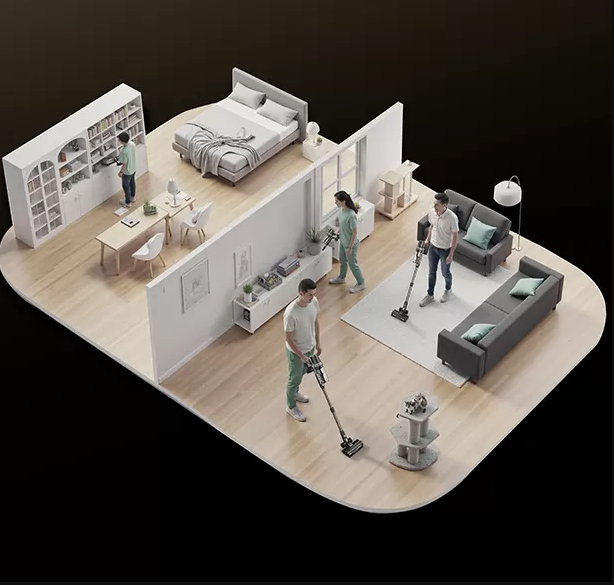
What Good Battery Performance Actually Means for a Professional Cordless Cleaning Tool in 2026
The marketing specification for a cordless cleaning tool battery — "up to X minutes runtime" — is a day-one figure measured under controlled conditions at the lowest power setting. For a facility manager deploying a fleet of tools across multiple sites and multiple shifts, the relevant performance metrics are different: runtime stability over the service life, cycle life before noticeable capacity loss, charging turnaround time, and the compliance documentation that allows the battery pack to be shipped, insured, and serviced without friction.
Runtime Stability Over the Service Life
A Li-ion cell loses capacity with each charge-discharge cycle. The rate of capacity loss depends on the depth of discharge per cycle, the charging rate, the operating temperature, and the quality of the battery management system that controls the charging and discharging process. A tool that is charged daily — as a commercial cleaning tool typically is — completes 300 to 400 cycles per year. At that cycle rate, a battery pack without adequate BMS protection can lose 20 to 30% of its initial capacity within the first year of service, reducing the DSV113A's 51-minute low-speed runtime to 35 to 40 minutes and creating a gap between the tool's performance and the cleaning route's time requirement.
For fleet buyers, runtime stability over 300 to 500 cycles is more operationally important than peak day-one runtime. A tool that delivers consistent 45-minute runtime across 500 cycles is more valuable than one that delivers 55 minutes on day one and 30 minutes after six months.
Cycle Life Definition
Cycle life is typically defined as the number of charge-discharge cycles before the battery reaches 80% of its initial capacity — the point at which the runtime reduction becomes operationally significant. The cycle life figure is only meaningful when the test conditions are specified: depth of discharge per cycle, ambient temperature, and charging rate. For rechargeable cleaning tool wholesale buyers specifying fleet equipment, request the cycle life definition — not just the number — and confirm the test conditions before using the figure in a TCO calculation.
Charging Safety Controls and Compliance Documentation
The BMS of a professional cordless cleaning tool should provide protection against the failure modes that cause battery incidents: overcharge, over-discharge, overcurrent, short circuit, and over-temperature. For tools deployed in commercial facilities where charging occurs overnight in storage rooms, the over-temperature and overcharge protections are the most operationally critical. For cross-border procurement, the compliance documentation package should include battery safety testing references — commonly UL 2054 or IEC 62133-2 depending on the market pathway — and UN 38.3 transport test evidence for international shipping.
How Li-ion Packs Determine Runtime and Why Motor Efficiency Is the Multiplier
The runtime of a Li-ion cordless cleaner is determined by a simple energy balance: the usable energy stored in the battery pack divided by the average power consumed by the tool during operation. Understanding this relationship is the foundation for comparing battery specifications across different tools and for evaluating the DSV113A's runtime performance across its three speed settings.
The Runtime Equation Applied to the DSV113A
Battery energy in watt-hours equals voltage multiplied by amp-hours. The DSV113A's 8-cell 2200 mAh pack at 29.6 V stores approximately 65 Wh of usable energy. The runtime at each speed setting reflects the average power draw at that operating point:
| Speed Setting | Suction | Runtime | Implied Average System Power |
|---|
| Low speed | 8 kPa | 51 minutes | Approximately 76 W average |
| Middle speed | 13.5 kPa | 28 minutes | Approximately 139 W average |
| High speed | 30 kPa | 15 minutes | Approximately 260 W average |
The 400 W wattage specification represents the peak motor power at maximum suction. The runtime at each speed setting reflects the actual average power draw at that operating point — which is significantly lower than peak wattage because the motor operates at partial load during normal cleaning. This is the efficiency benefit of a three-speed control system: the operator selects the power level that the task requires, and the battery delivers only the energy that the task consumes.
Why Motor Efficiency Extends Runtime Without Adding Weight
The relationship between motor efficiency and runtime is direct: a motor that converts a higher percentage of electrical energy into airflow and suction — rather than heat and mechanical losses — draws fewer watts for the same cleaning performance, which extends the runtime from the same battery pack. Wintech's design emphasis on optimized, energy-saving motors is the mechanism that makes the DSV113A's 65 Wh pack deliver 51 minutes of useful cleaning time at low speed rather than the 40 to 45 minutes that a less efficient motor system would produce from the same energy storage.
For high-capacity cordless duster applications where the tool is used continuously across a long cleaning route, the motor efficiency advantage compounds: a 10% improvement in motor efficiency translates directly into a 10% increase in runtime, which may be the difference between completing a cleaning zone on a single charge and requiring a battery swap mid-route.
Why the BMS Matters as Much as the Cells
The battery management system is the electronic control layer that sits between the Li-ion cells and the motor system. It monitors cell voltage, current, and temperature in real time and intervenes to prevent the conditions that cause cell damage and safety incidents: overcharge, over-discharge, overcurrent, short circuit, and over-temperature. A BMS that allows cells to be overcharged — even briefly — accelerates capacity fade and increases the risk of thermal runaway. A BMS that allows cells to be over-discharged — run below the minimum safe voltage — causes irreversible capacity loss that shortens the pack's service life.
For professional cordless cleaning tool applications where the tool is charged daily and operated by multiple users across shifts, the BMS quality determines whether the battery pack delivers its rated cycle life or fails prematurely — and whether the charging process is safe in an unattended overnight charging environment.
Key Specifications for Comparing Li-ion Batteries in a Cordless Cleaning Tool: The RFQ Checklist
Translating battery performance requirements into procurement specifications requires locking the parameters that determine both the runtime performance and the service life of the battery system.
Battery Pack Parameters
| Parameter | What to Specify | Why It Matters |
|---|
| Pack voltage | 14.8 V, 21.6 V, 25.2 V, or 29.6 V class | Determines the motor power range and compatibility with charger and dock |
| Capacity (Ah or mAh) | Minimum Ah at rated voltage | Determines the energy storage before efficiency losses |
| Usable energy (Wh) | Request explicitly — Wh = V × Ah | Best apples-to-apples comparison metric across different voltage classes |
| Cell format | 18650, 21700, or pouch | Affects pack geometry, weight, and thermal management |
| Pack architecture | Series and parallel cell count | Determines voltage, capacity, and redundancy |
The DSV113A's 2200 mAh × 8 cells at 29.6 V configuration uses eight cells in a series-parallel arrangement that produces the 29.6 V nominal pack voltage. Requesting the usable Wh figure — rather than just the mAh and voltage separately — allows direct comparison with competing tools that use different cell counts and voltage classes.
Cycle Life and Depth of Discharge
Request the cycle life specification with the test conditions: depth of discharge per cycle (100% discharge produces fewer cycles than 80% discharge), ambient temperature during testing, and the capacity threshold that defines end of life (typically 80% of initial capacity). For a commercial cleaning tool fleet that charges daily, a cycle life of 500 cycles to 80% capacity at 100% depth of discharge is a meaningful specification. A cycle life figure without these conditions cannot be used in a TCO calculation.
The practical implication for fleet operators is that operating the DSV113A primarily at low or middle speed — rather than running it at high speed until the battery is depleted — reduces the depth of discharge per cycle and extends the pack's service life. The three-speed control system is not just a performance feature; it is a battery life management tool.
Charging Safety Controls and Documentation Pack
BMS protections to require in the specification:
Overcharge protection — cuts off charging when cell voltage reaches the maximum safe level. Over-discharge protection — cuts off discharge when cell voltage drops below the minimum safe level. Overcurrent protection — limits the discharge current to prevent motor stall conditions from damaging the cells. Short-circuit protection — disconnects the pack immediately if a short circuit is detected. Over-temperature protection — cuts off charging or discharging if cell temperature exceeds the safe operating range.
Documentation to request from the supplier: UL 2054 or IEC 62133-2 battery safety testing reference for the target market, UN 38.3 transport test evidence for international shipping, and the SDS for the battery pack for storage and handling compliance.
System Efficiency: The Hidden Specification
The motor type — brushed versus brushless — affects the average power draw at each speed setting and therefore the runtime from the same battery pack. A brushless motor eliminates the friction and electrical losses of brush contact, producing higher efficiency and longer service life than a brushed motor of equivalent power rating. The airflow path efficiency, the brush head power draw, and the filter loading behavior also affect the average system watts during operation — a clogged filter increases the motor's workload and reduces runtime even with a fully charged battery.
Application Scenarios: Matching Battery Strategy to Each Cordless Cleaning Tool Use Case
Commercial Quick-Response Cleaning
For retail stores, cinema auditoriums, and office buildings where the cleaning task is light to moderate soil removal across a defined zone between operating periods, the DSV113A's low-speed mode — 51 minutes at 8 kPa suction — provides the runtime to complete a standard cleaning route on a single charge. The 1.5-hour charge time allows a full recharge during a break or between shifts, and the one-click hygienic dustbin release reduces the time and contact required for emptying between zones.
For this application, the battery strategy is single-pack operation with a standardized charging dock at the storage point — no spare pack required if the cleaning route fits within the 51-minute low-speed runtime and the charge time fits within the break between routes.
Back-of-House and Warehouse Cleaning
For warehouse aisles, back-of-house food service areas, and workshop floors where the dust load is higher and the debris is coarser, the DSV113A's high-speed mode — 30,000 Pa suction at 15 minutes runtime — provides the suction power to lift embedded debris from textured floor surfaces. The higher dust load in these environments increases filter resistance over the course of a cleaning session, which increases the motor's workload and reduces runtime compared to a clean-filter baseline.
For this application, the battery strategy requires either a spare pack for mid-route swap or a cleaning route design that fits within the available runtime at the required speed setting. The 0.65-liter dustbin capacity is a relevant constraint for high-debris environments — confirm the emptying frequency required for the specific debris load before finalizing the route design.
Mixed-Task Teams and Platform Consolidation
For cleaning teams that handle multiple task types — floor vacuuming, upholstery cleaning, crevice cleaning, and above-floor dusting — the DSV113A's accessory set (2-in-1 brush tool, crevice nozzle, and small brush) covers the range of cleaning tasks from a single platform. The LED floor brush with dust-revealing illumination eliminates cleaning blind spots on dark floor surfaces, and the smart LED display provides real-time battery level and speed mode information that allows the operator to manage power consumption across a long cleaning route.
For rechargeable cleaning tool wholesale buyers consolidating SKUs across multiple sites, a single platform that covers multiple task types reduces the number of distinct models in the fleet, simplifies training, and reduces the spare parts inventory required to maintain the fleet.
Selection Workflow, Battery Maintenance, and TCO: Building an ROI-Positive Cordless Program
Text-Based Selection and Rollout Workflow
Step one: define the task mix and minimum runtime per shift for each tool type. For the DSV113A, confirm whether the cleaning route fits within the 51-minute low-speed runtime or whether middle or high speed is required for the soil type, and whether the 1.5-hour charge time fits within the available break between routes.
Step two: set the battery KPI targets. Define the minimum acceptable runtime after 300 cycles — the one-year service life benchmark for a daily-charged tool — and the maximum acceptable charge time for the shift pattern. For a two-shift operation, a 1.5-hour charge time allows a full recharge between shifts without requiring a spare pack.
Step three: specify the compliance documentation required for the procurement channel and shipping lane. Confirm whether UL 2054, IEC 62133-2, or UN 38.3 transport test evidence is required for the target market before placing the order.
Step four: pilot with real operators. Measure the cleaning minutes per charge under actual operating conditions — not the specification sheet conditions — and confirm the recharge turnaround time and the dustbin emptying frequency for the specific soil load and floor type.
Step five: lock the spares plan. Define the replacement pack, charger, filter, and brush replacement schedule based on the pilot data, and stock the consumables before the full fleet rollout.
Battery Maintenance Practices That Protect Service Life
Avoid storing packs fully depleted — Li-ion cells stored at zero charge suffer accelerated capacity loss. Follow the supplier's storage guidance for packs that will not be used for more than two weeks. Keep charging areas ventilated and standardized — overnight charging in enclosed, unventilated spaces increases the ambient temperature around the charging packs, which accelerates capacity fade and increases the risk of thermal events. Track pack health by site — replace packs proactively when runtime drops below the operational threshold rather than waiting for a pack failure that causes a service level miss.
TCO and ROI Framework
| Cost Item | Low-Quality Battery System | DSV113A Li-ion System |
|---|
| Runtime after 300 cycles | Significant fade — 30 to 40% capacity loss | Stable with proper BMS and storage practice |
| Spare packs required per site | Higher — faded packs require more swaps | Lower — predictable runtime reduces swap frequency |
| Labor minutes lost to battery swaps | Higher — mid-route swaps interrupt cleaning flow | Lower — 51-minute low-speed runtime covers most routes |
| Return and warranty claim rate | Higher — inadequate BMS generates safety incidents | Lower — full BMS protection reduces incident rate |
| Compliance documentation friction | Higher — missing UN 38.3 delays cross-border shipment | Lower — documentation pack supports smooth procurement |
| Filter and suction maintenance | Higher — clogged filters increase power draw and reduce runtime | Lower — three-stage HEPA filtration maintains airflow efficiency |
Conclusion
In 2026, the battery system is the real engine of a cordless cleaning tool program — and the motor efficiency that draws from it is the multiplier that determines how many cleaning minutes that battery delivers per charge. The Wintech DSV113A demonstrates what a well-specified Li-ion cordless cleaner looks like: an 8-cell 220 mAh pack at 29.6 V delivering up to 51 minutes of runtime at low speed, a 400 W motor system with three-speed control that matches power consumption to task requirements, 30,000 Pa maximum suction, three-stage HEPA filtration capturing 99.97% of particles, a .65-liter one-click dustbin, and a 1.5-hour charge time — with OEM and ODM customization and bulk supply support for fleet buyers.
As one of the reliable cordless vacuum cleaner suppliers for commercial and wholesale procurement, Wintech supports buyers in specifying the battery system by usable Wh, cycle life definition, BMS protection requirements, and compliance documentation — not just the mAh figure on the label. Visit the Wintech product page to review the full cordless cleaner range and submit your requirements for a matched configuration recommendation and quotation.
Get Your Recommended Configuration and Quote
Visit the Wintech product page to review the full range, then submit the following details to receive a matched configuration and quotation:
| Parameter | What to Provide |
|---|
| Work condition | Facility type, dust and wet soil mix, cleaning frequency, shift length, noise limits |
| Quantity | Units per site, spare battery and charger quantities, rollout schedule |
| Size and spec | Tool type (stick, handheld, wet-dry, or floor washer), target battery Wh or V plus Ah, charger and dock style, filtration requirement |
| Target metrics | Runtime at standard and max mode, charge time, cycle-life target to 80% capacity, safety and compliance document needs |
| Current problem | Runtime drop over time, slow charging, battery overheating risk, high return rate, inconsistent suction, insufficient spares |
FAQ
1. What is a cordless cleaning tool?
A cordless cleaning tool is a battery-powered vacuum, mop, or scrubber that eliminates the power cord to improve operator mobility and remove cable trip hazards. Its productivity depends on battery usable energy in watt-hours, motor efficiency, and charging system design. The Wintech DSV113A is a Li-ion cordless cleaner with a 29.6 V 2200 mAh × 8 cell pack, 400 W motor, 30,000 Pa suction, and 51-minute low-speed runtime — designed for both residential and commercial cleaning applications with bulk procurement and OEM/ODM support.
2. Cordless vs corded vs gas-powered cleaning equipment — which is better?
Corded tools provide stable power for long continuous sessions but limit operator mobility and create cable management and trip hazard issues in large commercial spaces. Cordless tools are the fastest option for distributed tasks, quick-response cleaning, and multi-zone routes where cord management would slow the operator — but battery strategy is critical to maintaining productivity across the service life. Gas-powered equipment provides high power for outdoor and industrial applications but generates noise and emissions that make it unsuitable for indoor commercial use. The correct choice depends on task duration, mobility requirements, indoor or outdoor environment, and the compliance constraints of the operating facility.
3. How does better Li-ion battery performance pay back the investment?
Higher usable watt-hours and slower capacity fade over the service life reduces the number of mid-route battery swaps, lowers the number of spare tools required per site, and cuts the labor minutes lost to charging downtime — improving the cost per cleaned square meter. For a fleet of 20 tools operating two shifts per day, a battery system that maintains 90% of its initial runtime after 300 cycles versus one that retains 70% can reduce the spare pack requirement by 30 to 40% and eliminate the service level misses that generate client complaints and contract penalties.
4. Do we need to modify our facility to adopt cordless cleaning tools?
No major facility modification is required. The typical operational additions are standardized charging stations at the storage point — a wall-mounted dock or a charging shelf with one outlet per tool — a spare pack workflow for routes that exceed the single-charge runtime, and operator training on the fill, empty, and filter maintenance routines. Building modifications are only required if a centralized charging room with dedicated ventilation is being installed for a large fleet — this is an optional enhancement for high-density deployments rather than a prerequisite for starting a cordless tool program.
5. What parameters should I provide for correct cordless cleaning tool selection and quoting?
Tool type (stick vacuum, handheld, wet-dry, or floor washer), expected runtime per shift at the required suction level, target battery energy in watt-hours or voltage plus amp-hours, recharge time target, cycle-life definition to 80% capacity, filtration requirement (HEPA or standard), noise limit, dustbin capacity requirement, accessory set needs, bulk quantity per site, and required compliance documents — UL 2054, IEC 62133-2, or UN 38.3 transport test evidence depending on the target market and shipping lane.

 EN
EN