Smart home cleaning is entering a new stage. For many households, a vacuum cleaner is no longer just a motor, a dustbin, and a brush. The most competitive products now combine sensors, mapping, artificial intelligence, automated charging, app control, and floor-type recognition to reduce the amount of human work required for daily cleaning. This is why the AI robot cleaner has become one of the most discussed categories in home appliances, smart living, and consumer robotics.
Global demand is supported by three clear changes in the market. First, consumers want cleaner homes with less time spent on repetitive chores. Second, smart home ecosystems are becoming more familiar, especially in apartments, family houses, pet households, and rental properties. Third, manufacturers are improving robot navigation, suction power, battery performance, obstacle avoidance, and mop-cleaning systems at a much faster pace than before. According to Statista, worldwide smart home market revenue is projected to reach about US$175.1 billion in 2026, showing how connected home devices are moving from niche products into mainstream living.
For distributors, retailers, importers, and private-label brands, the rise of AI cleaning appliances creates a practical business opportunity. Buyers are not only looking for a robot vacuum that “moves by itself.” They want a reliable cleaning system that can understand spaces, avoid common obstacles, handle pet hair, support wet and dry cleaning, return to the charging dock, and deliver a consistent experience after months of use. That is also why working with an experienced manufacturer such as Wintech matters: product design, quality control, export readiness, ODM/OEM flexibility, and after-sales support all influence long-term customer satisfaction.
What Is an AI Robot Cleaner
An AI robot cleaner is an autonomous cleaning device that uses sensors, software algorithms, and motorized cleaning systems to navigate indoor or outdoor spaces and remove dust, debris, hair, stains, or other dirt with limited human operation.
In simple terms, an AI robot cleaner is a cleaning appliance that can sense its surroundings, decide where to go, clean the target area, and usually return to a charging station when the task is complete. The category can include robotic vacuum cleaners, vacuum-and-mop robots, robot pool cleaners, robot lawn mowers, and commercial cleaning robots. In the home cleaning context, the most familiar model is the robotic vacuum cleaner, but the broader AI robot cleaner market is becoming more diverse as consumers expect automation across floors, carpets, pools, lawns, and multi-room spaces.
The word “AI” does not mean that every robot cleaner thinks like a human. It means the product uses intelligent functions to improve cleaning decisions. These functions may include mapping, room division, cleaning path planning, carpet detection, drop prevention, obstacle recognition, suction adjustment, water-flow control, no-go zones, automatic recharge, and app-based scheduling. More advanced models may combine LiDAR, structured light, camera-based recognition, ultrasonic detection, and machine-learning object classification to perform more efficiently in real homes.
The International Federation of Robotics describes consumer service robots as products used by non-professional users, including domestic cleaning robots. This classification is important for B2B buyers because it shows that AI robot cleaners are part of a broader service robotics movement, not just a small household appliance trend. As automation becomes more accepted in homes, the products that win market share will be those that combine usability, safety, performance, and dependable manufacturing quality.
Compared with early random-path robot vacuums, today’s AI robot cleaners are designed to be more predictable. Instead of bumping around until the battery runs low, many new models scan the room, build a map, calculate a cleaning route, and adjust their behavior based on the floor condition. This improves coverage, reduces missed areas, and makes the cleaning process easier to understand for the user. For families with children or pets, this reliability is especially valuable because dust, crumbs, pet hair, and tracked-in dirt can appear every day.
From a buyer’s perspective, the product category can be divided into several performance levels. Entry-level models focus on basic vacuuming and simple obstacle avoidance. Mid-range models usually add app control, planned cleaning routes, stronger suction, and better edge cleaning. Premium models may include self-emptying dust stations, auto mop washing, hot-air drying, automatic water supply, carpet lift technology, and advanced object recognition. This tiered structure gives retailers and distributors room to build a complete product line for different price points and customer needs.
Wintech positions its intelligent cleaning solutions around practical automation for everyday environments. The company’s AI robot cleaner category covers smart robots for floors, pools, lawns, and other cleaning scenarios, helping business customers source products that match different market segments. This matters because the best-selling AI robot cleaner for a compact apartment may not be the same as the right solution for a suburban home, a pet household, or a commercial showroom.
The main reason consumers are paying attention to AI robot cleaners is not only technology novelty. It is the practical promise of time saving. A robot that can clean under furniture, follow a daily schedule, and maintain floors between deep-cleaning sessions reduces the pressure of manual housekeeping. For modern consumers who work long hours, live in smaller urban spaces, raise pets, or prefer low-maintenance homes, this value is easy to understand.
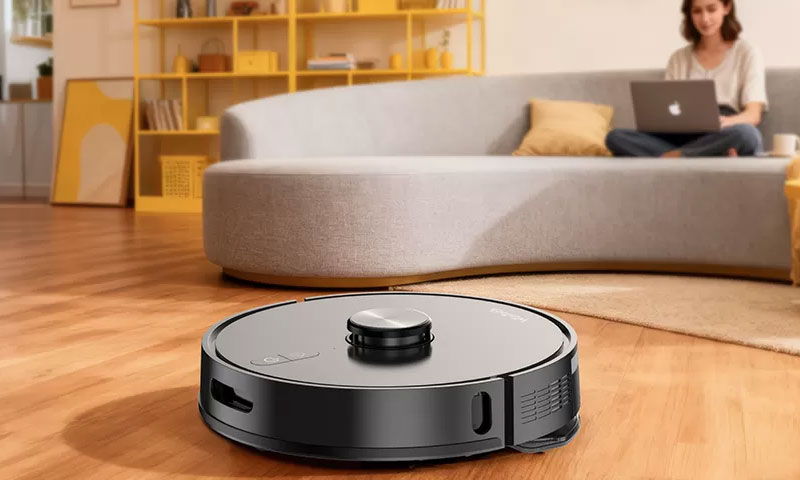
How Does an AI Robot Cleaner Work?
An AI robot cleaner works by combining environmental sensing, digital mapping, path-planning algorithms, suction or mopping hardware, battery management, and user controls to clean a defined space automatically.
The operating process begins when the robot collects information about the room. Sensors detect walls, furniture, stairs, carpet edges, table legs, shoes, cables, and other objects. Depending on the product design, this sensing may come from LiDAR, infrared sensors, ultrasonic sensors, cliff sensors, bump sensors, gyroscopes, wheel encoders, or visual cameras. The more accurately a robot can sense its surroundings, the better it can avoid repeated collisions and clean with a logical pattern.
After sensing the environment, the robot builds or updates a map. Mapping is one of the biggest differences between a basic robot vacuum and a smart AI robot cleaner. A mapped cleaning route can divide the home into rooms, remember cleaned and uncleaned zones, and support customized cleaning. For example, a user may set the robot to clean the kitchen after dinner, avoid a child’s play mat, increase suction on carpets, or skip the bathroom when the door is closed.
The next step is path planning. Instead of moving randomly, the robot calculates an efficient route. Many models use S-shaped or grid-based cleaning paths to cover the floor systematically. When the robot meets an obstacle, it updates its route and continues cleaning. When the battery becomes low, the product can return to the dock, recharge, and in some models resume cleaning from the place where it stopped. This makes whole-home cleaning more dependable, especially in larger spaces.
The cleaning system then performs the physical work. A robotic vacuum cleaner may use a main roller brush, side brushes, suction channels, a dustbin, a filter, and a motor. Vacuum-and-mop models may add water tanks, mop pads, rotating mops, vibration mopping, or water-flow control. Premium models can lift mop pads when carpet is detected, increase suction on rugs, wash mop pads at the base station, dry them with warm air, and collect debris into a larger dust bag. These functions make the AI robot cleaner more like a cleaning system than a single device.
Market demand reflects these functional improvements. Mordor Intelligence estimates the robot vacuum cleaner market at about US$7.05 billion in 2026, with a projected rise to US$13.29 billion by 2031. While different research firms may produce different forecasts, the direction is consistent: AI navigation, smart-home integration, improved batteries, and hands-free maintenance are making robot cleaners more attractive to global buyers.
User control is another key part of how an AI robot cleaner works. Many products can be controlled through mobile apps, voice assistants, remote controls, or onboard buttons. App control allows users to schedule cleaning, choose rooms, adjust suction, set water levels, create no-go zones, view maps, and check maintenance reminders. For B2B customers, these software features are important because they influence reviews, return rates, and repeat purchases. A product with strong cleaning power but confusing controls may still disappoint consumers.
Battery management also affects the customer experience. An AI robot cleaner must balance suction power, runtime, charging speed, weight, and cost. Higher suction can remove more debris, but it uses more energy. Larger batteries support longer cleaning sessions, but they may increase cost and product weight. Strong engineering is needed to maintain stable performance without overheating, excessive noise, or quick battery degradation. This is one reason manufacturers with mature product development and testing processes are more valuable to importers and private-label brands.
Finally, a robot cleaner needs maintenance logic. The user may need to empty the dustbin, clean the filter, replace side brushes, wash or replace mop pads, and remove tangled hair from the roller brush. Newer self-cleaning stations reduce this work by storing debris, washing mop pads, and drying them to reduce odor. However, the best product design still makes maintenance easy to understand. Clear dustbin access, washable components, available spare parts, and intuitive alerts can increase satisfaction after purchase.
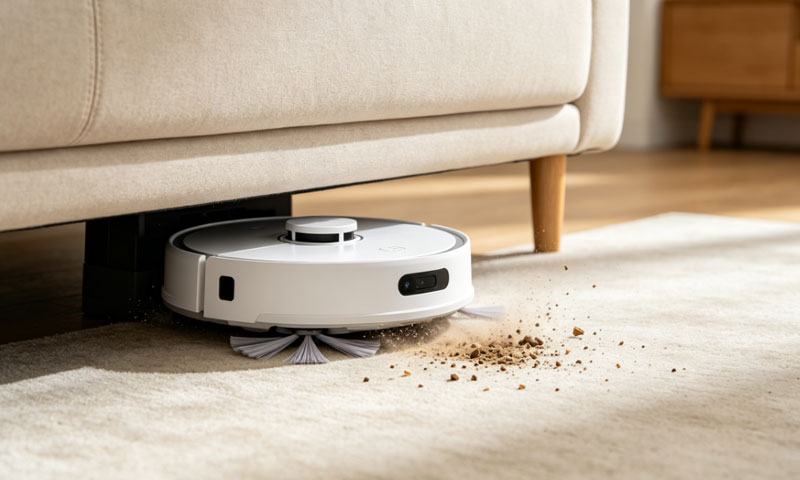
Key Benefits of Using an AI Robot Cleaner
The key benefits of using an AI robot cleaner are hands-free daily maintenance, more consistent floor coverage, better time efficiency, smart cleaning customization, and improved convenience for homes with pets, children, busy schedules, or hard-to-reach spaces.
Time Saving
Floor cleaning is repetitive, and repetitive tasks are where automation becomes most useful. An AI robot cleaner can run while the user is working, cooking, resting, or away from home. It does not replace every deep-cleaning task, but it reduces visible dust and debris between manual cleaning sessions. For many households, that daily maintenance is the main value proposition.
Consistency
Humans often clean only when dirt becomes visible, while a robot can clean according to a schedule. This matters for pet hair, food crumbs, pollen, and dust that build up slowly. Scheduled cleaning can keep floors looking better throughout the week and reduce the effort needed during weekend deep cleaning. In homes with pets, frequent robot vacuuming can be especially attractive because pet hair tends to accumulate quickly around sofas, beds, carpets, and corners.
Access to Difficult Spaces
Many robot cleaners can move under beds, sofas, cabinets, and low furniture where upright vacuums are harder to use. Edge-cleaning brushes help remove debris near walls and furniture legs. While no robot can clean every hidden corner perfectly, regular automated cleaning can reduce the amount of dust left in areas that users often forget.
Customized Cleaning
AI robot cleaners with app control can support different cleaning plans for different rooms. The kitchen may need stronger suction and more frequent cleaning. Bedrooms may require quiet mode. Carpets may need automatic suction boost. Hard floors may benefit from vacuum-and-mop modes. This flexibility turns one device into a more personalized cleaning assistant.
Ease of Use for Consumers
Traditional vacuum cleaners can be difficult for some users because they require pushing, pulling, bending, moving cords, and carrying the device across rooms. An AI robot cleaner reduces these physical actions. Although users still need to maintain the device, the day-to-day cleaning workload becomes lighter.
Potential for Better Long-Term Home Hygiene
A robot cleaner that runs frequently can remove everyday particles before they spread across the floor. This is not a medical claim, and cleaning results depend on filter quality, suction strength, floor type, and maintenance. However, frequent debris removal is a practical advantage for households that want a cleaner living environment without spending more manual labor.
For retail and wholesale buyers, the benefits also translate into commercial selling points. A strong AI robot cleaner product page can highlight automatic cleaning, smart navigation, obstacle avoidance, multiple cleaning modes, low-maintenance docking, pet-hair cleaning, and convenient app control. These features are easy for consumers to understand, making them useful for e-commerce descriptions, comparison charts, social media videos, offline demonstrations, and live-stream selling.
Wintech’s cordless robotic vacuum cleaner solutions are designed for buyers who need smarter floor-cleaning products for modern households. For B2B partners, this product positioning supports multiple sales channels: online retail, appliance stores, brand distribution, promotional product bundles, and private-label programs. When a robot cleaner looks modern, cleans reliably, and is backed by stable manufacturing, it becomes easier to convert interest into inquiries.
Another benefit for distributors is product differentiation. The AI robot cleaner category gives brands more ways to stand out than a basic vacuum category. Product differences can include suction power, navigation type, mop-lifting function, dust station capacity, noise level, battery runtime, app features, brush design, filter structure, color options, and packaging. This makes ODM/OEM customization valuable because a brand can adapt features and appearance to the expectations of its target market.
In practical purchasing decisions, buyers should evaluate the whole cleaning experience instead of relying on a single specification. Very high suction power may sound attractive, but route coverage, brush efficiency, dustbin design, filter performance, noise control, battery stability, spare parts, and docking reliability also matter. A balanced AI robot cleaner usually performs better in real customer reviews than a product that focuses on only one headline number.
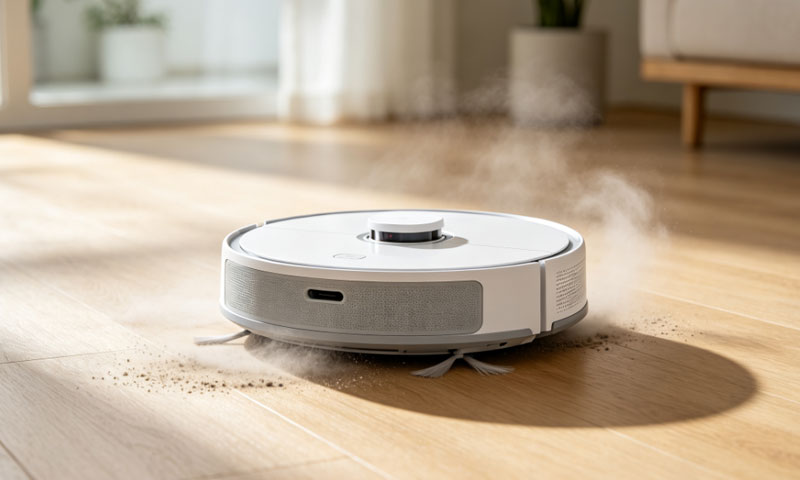
AI Robot Cleaner vs Traditional Vacuum Cleaner
An AI robot cleaner differs from a traditional vacuum cleaner by automating navigation, route planning, and scheduled cleaning, while a traditional vacuum cleaner depends on manual operation and direct user control.
Both product types are useful, but they solve different cleaning problems. A traditional vacuum cleaner is still excellent for deep cleaning, stairs, upholstery, tight crevices, curtains, car interiors, and heavy debris. An AI robot cleaner is strongest for routine floor maintenance, daily dust control, and cleaning under low furniture. The smartest home cleaning strategy may use both: a robot cleaner for everyday floor care and a manual vacuum for targeted deep cleaning.
For consumers, the main difference is effort. A traditional vacuum cleaner requires the user to take it out, move it across rooms, manage power cords or batteries, clean specific spots, and put it away. An AI robot cleaner can be scheduled and left to work with limited supervision. This convenience is the reason many users adopt robot cleaners even if they already own a stick vacuum or handheld vacuum.
The comparison below can help buyers, retailers, and product managers explain the difference clearly.
| Comparison Factor | AI Robot Cleaner | Traditional Vacuum Cleaner | Best Choice for Buyers |
|---|
| Cleaning Method | Autonomous route planning, scheduled cleaning, smart sensors, automatic recharge | Manual pushing, direct control, user-selected cleaning path | Choose robot cleaners for daily maintenance and traditional vacuums for deep cleaning |
| User Effort | Low daily effort after setup; maintenance still required | Higher effort because the user controls the full cleaning process | Robot cleaners suit busy homes, pet owners, and users who prefer automation |
| Coverage | Good for open floors, under furniture, repeated scheduled cleaning | Good for corners, stairs, upholstery, curtains, and targeted debris | A combined product portfolio can meet more household cleaning needs |
| Smart Features | Mapping, no-go zones, app control, carpet detection, suction adjustment, docking station support | Usually limited to power modes, attachments, and battery indicators | AI features support premium pricing and easier product differentiation |
| Maintenance | Dustbin, filter, brushes, mop pads, sensors, and station parts require regular care | Dust cup or bag, filter, brush, and attachments require care | Self-emptying and self-washing stations reduce user workload |
| Price Positioning | Often mid-range to premium, depending on navigation and docking functions | Wide range from budget to professional models | Retailers can offer both categories to increase basket value |
This comparison also explains why AI robot cleaners are not simply replacing all vacuum cleaners. Instead, they are expanding the cleaning appliance category. Many households may buy a robot vacuum first for daily maintenance, then also keep a cordless stick vacuum or handheld vacuum for stairs, sofas, cars, and quick spot cleaning. For B2B buyers, this creates cross-selling opportunities across product categories.
Wintech’s broader vacuum cleaner range supports this combined approach. A brand or distributor can source AI robot cleaners for automated floor care and other vacuum products for targeted household cleaning. This is more strategic than promoting one product type as the answer to every cleaning problem. It helps consumers choose the right tool and can improve conversion because the recommendation feels more practical.
For importers and private-label brands, the comparison also clarifies product planning. If the target market already has strong cordless vacuum adoption, an AI robot cleaner can be positioned as an upgrade for convenience. If the market is price-sensitive, a basic planned-navigation model may be the right entry point. If the market is premium, features such as auto-emptying, mop washing, hot-air drying, carpet recognition, and advanced obstacle avoidance become more persuasive.
Future Trends of AI Robot Cleaners
The future trends of AI robot cleaners include more accurate object recognition, stronger vacuum-and-mop integration, better self-maintenance stations, deeper smart-home connectivity, improved battery efficiency, and broader use across residential and light-commercial environments.
Trend 1: Improved Perception and Obstacle Recognition
Future AI robot cleaners will keep upgrading the recognition capability of daily household items. Cables, socks, pet bowls, slippers, toys, chair legs and floor boundary transitions are the main factors that cause cleaning interruptions and robot stalling.More precise obstacle identification effectively reduces machine stuck failures and greatly improves user satisfaction and product reviews. For B2B buyers, navigation and perception technology will continue to be the core product differentiation advantage in the market.
Trend 2: Upgraded All-in-One Automatic Cleaning Capability
Modern consumers have put forward higher integrated requirements for cleaning robots, expecting a single device to realize full-process automatic cleaning functions: vacuuming, mopping, self-cleaning mop pads, self-drying mop pads, automatic dust collection, water refilling and automatic resumption of cleaning tasks.High-end base stations have become a key competitive point of products, as they solve the most troublesome problem of robot use — manually cleaning the equipment itself. The more powerful the base station’s debris processing and mop maintenance functions are, the higher the hands-free degree of the overall cleaning experience will be.
Trend 3: Intelligent Floor Adaptation
Family floors usually have mixed materials, including tile, solid wood, laminate, rugs and carpets. Next-generation AI cleaning robots can automatically identify different floor surfaces and match targeted cleaning modes.Specific adaptive adjustments include increasing suction power for carpets, reducing water flow to protect wood floors, lifting mop pads when passing rugs, and strengthening repeated cleaning for high-traffic dirty areas. This intelligent adjustment improves cleaning efficiency and avoids cleaning defects, effectively reducing user complaints.
Trend 4: Low Noise and High Energy Efficiency Operation
Noise has always been a key pain point of household cleaning appliances. Users hope that robots can work normally during working from home, studying, watching TV or sleeping without disturbance.Therefore, manufacturers need to optimize multiple dimensions including air circulation design, motor structure, brush configuration and sound insulation technology. Meanwhile, battery energy efficiency is equally critical. Longer battery life and stable suction performance enable the robot to complete large-area cleaning tasks without frequent charging, improving overall cleaning efficiency.
Trend 5: Intelligent Software and Smart Home Integration
The software system of cleaning robots will be more intelligent and user-friendly. The household mapping APP will be simpler to operate, and voice control and smart home linkage functions will become standard configurations of mainstream products.Users can realize precise customized cleaning through voice or APP instructions, such as "clean the kitchen", "avoid the nursery room" and "mop the dining room after dinner". For brands and manufacturers, software reliability is as important as hardware performance, and will become a core factor affecting long-term market competitiveness.
Trend 6: Scenario Expansion Beyond Residential Floor Cleaning
With the continuous popularization of intelligent automation in household and commercial scenarios, cleaning robots are no longer limited to indoor residential floor cleaning. Product forms such as robotic pool cleaners, intelligent lawn mowers and light commercial cleaning robots are gaining increasing market attention.This brings new development opportunities for distributors and importers. Brands engaged in household sweeping robots can expand their product portfolios by launching pool cleaning robots, lawn care robots and other products to cover new customer groups and expand market share.
Trend 7: Enhanced Privacy and Data Security Protection
Intelligent cleaning robots have functions such as home mapping, Wi-Fi connection, mobile APP linkage and cloud data interaction, which involve a large amount of user household data information.Especially for high-end models equipped with camera-based recognition systems, data transmission, APP permission management, firmware update mechanisms and user privacy protection systems are crucial. In the consumer market that pays increasing attention to the security of smart connected devices, perfect privacy and data security capabilities will become important competitive advantages of brands.
Trend 8: Professional OEM & ODM Customized Collaboration
As the industry competition intensifies, homogeneous generic products can no longer meet market demand. More brands tend to customize differentiated products according to regional markets and user groups.Customized demands cover product color, brand logo, packaging design, supporting accessories, battery parameters, suction mode setting, regional certification support and after-sales service documents. Manufacturers with rich export experience can help buyers reduce product launch risks and shorten the cycle from product selection to market landing.
Supplier Advantage: Wintech’s Layout for Industry Development Trends
Wintech is highly compatible with the above industry development trends and has outstanding comprehensive strength in the field of intelligent cleaning equipment. The company has a rich product portfolio of intelligent cleaners and strong manufacturing capabilities, including modern standardized factories, skilled professional production teams, and has exported products to more than 30 countries and regions.With years of professional experience in cleaning appliance R&D and manufacturing, Wintech provides reliable support for international buyers. All strength indicators are not empty brand publicity, but can effectively reduce the cooperation risk of buyers, and provide solid guarantee for repeated orders, private label customization and long-term product strategic planning.
FAQ About AI Robot Cleaners
1. Is an AI robot cleaner worth it for a modern home?
Yes, an AI robot cleaner is worth considering if you want regular floor maintenance with less manual effort. It is especially useful for busy households, pet owners, families with children, and people who want scheduled cleaning. It may not fully replace deep cleaning, but it can keep floors cleaner between manual cleaning sessions.
2. What is the difference between an AI robot cleaner and a robot vacuum?
A robot vacuum usually refers to an autonomous floor vacuum, while an AI robot cleaner is a broader term that may include vacuuming, mopping, pool cleaning, lawn mowing, and other automated cleaning tasks. In many product pages, the terms overlap, but “AI robot cleaner” emphasizes smarter sensing, navigation, and decision-making features.
3. How does an AI robot cleaner avoid obstacles?
An AI robot cleaner avoids obstacles through sensors such as LiDAR, infrared detection, bump sensors, ultrasonic sensors, cliff sensors, or cameras. The robot uses these signals to detect walls, furniture, stairs, and objects on the floor, then adjusts its route to reduce collisions and improve cleaning coverage.
4. Can an AI robot cleaner replace a traditional vacuum cleaner?
An AI robot cleaner can reduce the need for frequent manual floor vacuuming, but it usually does not replace every traditional vacuum task. A manual vacuum is still better for stairs, curtains, sofas, car interiors, tight corners, and heavy spot cleaning. Many homes benefit from using both product types.
5. What features should B2B buyers look for in an AI robot cleaner?
B2B buyers should evaluate navigation accuracy, suction power, battery runtime, floor adaptation, mop functions, dust station design, filter structure, noise level, spare parts, certification support, packaging options, and ODM/OEM flexibility. A balanced product with stable quality is usually easier to sell than a model with only one impressive specification.
6. Why choose Wintech for AI robot cleaner sourcing?
Wintech offers intelligent cleaning solutions for different environments, including robotic vacuum cleaners and other smart cleaning products. For importers, distributors, and private-label brands, Wintech can support product selection, customization, quality control, and export-oriented supply requirements, helping buyers build competitive cleaning appliance portfolios.
Conclusion
Artificial intelligence is transforming smart home cleaning because it changes the role of the cleaning appliance. Instead of waiting for a user to push, pull, and control every movement, an AI robot cleaner can sense the environment, plan a route, clean automatically, return to its dock, and support personalized cleaning schedules. This makes the product category highly relevant for today’s connected homes.
The strongest value of an AI robot cleaner is not technology for its own sake. It is the combination of time saving, floor cleanliness, convenience, and repeatable performance. Consumers want products that make daily life easier, while B2B buyers want reliable solutions that can compete in fast-growing smart appliance markets. With global smart home adoption rising and the robot vacuum cleaner market forecast to keep expanding, AI cleaning products are becoming an important category for retailers, distributors, and private-label brands.
For companies planning to source AI robot cleaner solutions, the supplier decision is critical. Product performance, navigation quality, battery stability, docking reliability, certifications, spare parts, packaging, and customization all affect market success. Wintech brings together intelligent cleaner product development, manufacturing capability, and export-oriented support to help global partners build cleaning appliance lines that match real consumer demand.
If your business is preparing to launch or upgrade an AI robot cleaner product line, now is the right time to evaluate product positioning, feature priorities, target price points, and customization opportunities. A well-designed AI robot cleaner can do more than clean floors; it can help your brand enter the future of smart home cleaning with a product consumers understand, value, and recommend.

 EN
EN